


B2B Search Engine Optimization Agency For a B2B company, getting found online is only half the SEO challenge.
The harder part is attracting the right people—buyers, decision-makers, procurement teams, technical evaluators, and business owners who may eventually become customers.
That is where a B2B search engine optimization agency can make a meaningful difference. Unlike consumer-focused SEO, B2B SEO often involves longer sales cycles, technical products, multiple decision-makers, industry-specific language, and keywords that may have relatively low search volume but significant commercial value.
A company might rank first for a keyword that receives thousands of searches and still generate very few qualified leads. Meanwhile, a specialized phrase searched by only a few hundred people each month could bring prospects who are actively looking for exactly what the company sells.
The goal, therefore, is not simply to increase website traffic. It is to build a search strategy that connects relevant business problems with useful content, strong visibility, qualified leads, and measurable revenue opportunities.
This guide explains what a B2B SEO agency does, how B2B SEO differs from traditional SEO, what services you should expect, how to evaluate an agency, common mistakes to avoid, and how to determine whether hiring one makes sense for your business.
What Is a B2B Search Engine Optimization Agency?
A B2B search engine optimization agency is a company that helps businesses improve their visibility in search engines and attract potential business customers through organic search.
B2B stands for business-to-business, meaning the company sells products or services to other organizations rather than primarily to individual consumers.
For example, a B2B SEO agency might work with:
- Software companies
- IT service providers
- Cybersecurity companies
- Industrial manufacturers
- Business consultants
- Accounting firms
- Logistics providers
- Commercial equipment suppliers
- Marketing technology companies
- Professional service firms
- Enterprise software providers
The agency’s job goes beyond inserting keywords into blog posts.
A good B2B SEO program may involve technical website improvements, keyword research, competitor analysis, content strategy, product and service page optimization, internal linking, digital PR, conversion optimization, analytics, and ongoing performance analysis.
Most importantly, the agency should understand the difference between website visitors and potential customers.
A thousand irrelevant visitors are not necessarily more valuable than 50 highly qualified prospects.
Why B2B SEO Is Different From Consumer SEO
One of the biggest mistakes companies make is assuming that B2B SEO works exactly like consumer SEO.
It does not.
A consumer searching for running shoes might search for:
“best running shoes”
A business buyer looking for enterprise software might search for:
“enterprise inventory management software”
But that same buyer could also search for:
“inventory management software implementation cost”
or:
“ERP inventory integration for manufacturers”
These searches reveal different stages of the buying journey.
B2B customers often research extensively before contacting a sales team. They may read comparison pages, download reports, examine product documentation, compare vendors, review pricing information, and consult colleagues.
The buying decision can involve several people.
A marketing manager might discover the product. A technical employee might evaluate it. A finance manager might review pricing. A department head might approve the purchase.
That makes B2B SEO more complicated—but also potentially very valuable.
What Does a B2B SEO Agency Actually Do?
The exact services vary between agencies, but a strong B2B SEO program usually covers several important areas.
1. B2B Keyword Research
Keyword research is the foundation of an effective SEO strategy.
However, B2B keyword research should not focus exclusively on search volume.
An agency should investigate:
- Search intent
- Business relevance
- Commercial value
- Competition
- Industry terminology
- Customer pain points
- Buying-stage keywords
- Product-related searches
- Comparison searches
- Problem-based searches
For example, imagine a company selling warehouse management software.
A broad keyword such as “warehouse” may receive significant search traffic but have little commercial value.
A more specific keyword such as “warehouse management software for small manufacturers” could have fewer searches but much stronger purchase intent.
This is why keyword quality matters more than keyword quantity.
2. Understanding Search Intent
Ranking for a keyword is not enough.
You need to understand what the searcher actually wants.
Consider these three searches:
“What is warehouse management software?”
This is primarily informational.
“Warehouse management software features”
This suggests deeper research.
“Warehouse management software vendors”
This is much closer to commercial investigation.
A B2B SEO agency should create different content for these different stages.
For example:
| Search Intent | Suitable Content |
|---|---|
| Informational | Guides and educational articles |
| Problem-focused | Tutorials and solution guides |
| Commercial | Service and product pages |
| Comparison | Comparison articles |
| Transactional | Product/demo/pricing pages |
| Navigational | Brand and product pages |
A strong strategy moves potential customers from learning to evaluating to taking action.
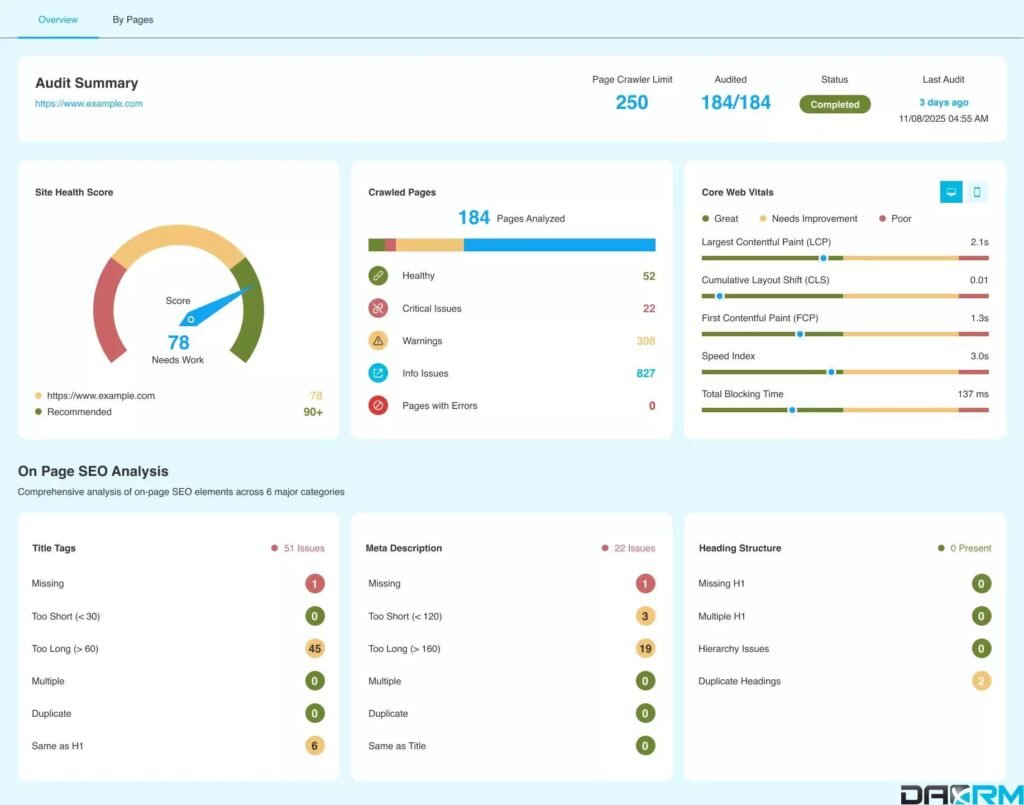
3. Technical SEO
Even excellent content can struggle if a website has technical problems.
A B2B SEO agency may perform a technical audit covering areas such as:
- Website architecture
- Indexing
- Crawlability
- Broken links
- Redirects
- Duplicate content
- Canonicalization
- Mobile usability
- Page experience
- Site speed
- Structured data
- XML sitemaps
- HTTPS
- Internal linking
Technical SEO is particularly important for large B2B websites.
A company might have hundreds or thousands of pages covering products, industries, locations, resources, integrations, documentation, and solutions.
Without a sensible structure, search engines and users can struggle to understand the site’s most important pages.
4. B2B Content Strategy
Content is one of the most important parts of B2B SEO.
But publishing dozens of generic articles every month is not automatically a strategy.
A useful B2B content plan should answer real customer questions.
For example, instead of publishing:
“10 Benefits of Technology”
a cybersecurity company could create a practical guide explaining how a small financial institution can evaluate its third-party security risks.
The second topic is more specific and more useful to a defined audience.
High-quality B2B content can include:
- Detailed guides
- Industry reports
- Product comparisons
- Case studies
- Implementation guides
- Buying guides
- FAQs
- Original research
- Templates
- Checklists
- Glossaries
- Technical explainers
- Industry-specific landing pages
The objective should always be usefulness first.
5. Optimizing Service and Product Pages
A common B2B SEO problem is having a website filled with blog posts while the pages that actually generate revenue receive little attention.
Your product and service pages deserve serious optimization.
A strong page should clearly communicate:
- What the product or service does
- Who it is for
- What problem it solves
- How it works
- Important features
- Business benefits
- Differentiators
- Evidence or customer results
- Frequently asked questions
- What the visitor should do next
Search engines need enough context to understand the page, while potential customers need enough information to decide whether the solution is relevant.
These goals can work together.
6. Competitor Analysis
A good B2B SEO agency should study competitors—not simply copy them.
Competitor analysis can reveal:
- Which keywords competitors rank for
- Which topics generate visibility
- Which pages attract links
- How their websites are structured
- What content gaps exist
- Which questions competitors fail to answer
- Where your company has a realistic opportunity
Suppose three competing companies have extensive content about “cloud accounting software.”
Instead of creating another generic article on the same subject, your company might identify an unanswered customer problem such as migration from legacy accounting systems.
That creates an opportunity to build something more specific and useful.
7. Building Authority and Trust
B2B buyers are often cautious.
They want evidence before committing money or time.
This makes authority particularly important.
A strong B2B SEO strategy can use:
- Original research
- Expert commentary
- Customer case studies
- Industry publications
- Relevant business partnerships
- High-quality earned links
- Author expertise
- Transparent company information
- Product documentation
- Customer reviews where appropriate
The goal is not to collect hundreds of random backlinks.
A single relevant mention from a respected industry publication may be more meaningful than dozens of unrelated links.
B2B SEO and the Long Sales Cycle
One reason B2B SEO can be difficult to measure is the long buying process.
Someone may discover your company through Google today but not become a customer for six months.
The journey could look like this:
Google search → educational article → product page → email signup → webinar → sales conversation → proposal → customer
If you measure only the first website visit, you may conclude that SEO is not working.
A better measurement system connects organic search with meaningful business outcomes.

Which B2B SEO Metrics Actually Matter?
Traffic is useful, but it should not be the only metric.
Important measurements can include:
Organic qualified traffic
Are the people arriving from search actually part of your target market?
Keyword visibility
Are important commercial and informational terms gaining visibility?
Leads
How many inquiries, demo requests, calls, or other meaningful conversions come from organic search?
Conversion rate
Are visitors taking useful actions?
Pipeline
How much potential sales value can be connected to organic search?
Revenue
Where possible, determine whether organic search contributes to closed business.
Non-branded search growth
This can help show whether your SEO strategy is reaching people who were not already searching for your company.
The best KPI depends on the business model.
A B2B software company, manufacturer, and consulting firm may need different measurement systems.
How to Choose the Best B2B Search Engine Optimization Agency
Choosing an SEO agency should not be based only on price or promises.
Ask potential agencies questions that reveal how they actually work.
Ask About Their B2B Experience
Ask:
“Have you worked with companies that have a similar sales cycle and audience?”
A company experienced in local restaurants may be excellent at local SEO but may not understand enterprise B2B buying behavior.
Look for evidence that the agency understands your industry and customer journey.
Ask How They Select Keywords
Be cautious if an agency says:
“We will target thousands of keywords.”
That sounds impressive but does not explain whether those keywords matter.
Ask:
“How will you determine which keywords have business value for us?”
The answer should involve customer intent, commercial relevance, competition, and your company’s offerings.
Ask What Happens in the First 90 Days
A professional agency should be able to explain its initial process.
The first phase may involve:
- Website audit
- Business and customer research
- Competitor analysis
- Keyword research
- Technical improvements
- Content planning
- Existing-page optimization
- Measurement setup
Be cautious if the first 90 days consist mainly of publishing generic blog posts without understanding the business.
Red Flags When Hiring an SEO Agency
Some warning signs should make you pause.
Guaranteed #1 Rankings
No legitimate agency can control Google’s rankings for every keyword.
Search results change because of competition, algorithmic systems, search intent, content quality, user behavior, and many other factors.
Promises of guaranteed rankings should be treated skeptically.
Huge Backlink Promises
“10,000 backlinks every month” sounds impressive but can be meaningless—or harmful.
SEO is not a numbers competition.
The relevance and quality of links matter.
Generic Monthly Reports
If your monthly report only says:
- Keywords increased
- Traffic increased
- Backlinks created
you may still have no idea whether the business is improving.
Good reporting connects SEO activity with meaningful outcomes.
Publishing for the Sake of Publishing
More content does not automatically mean better SEO.
A smaller number of genuinely useful pages can outperform a large collection of thin, repetitive articles.
How Much Does B2B SEO Cost?
There is no single price for B2B SEO.
Costs can vary based on:
- Website size
- Competition
- Industry
- Geographic market
- Technical complexity
- Number of products
- Content requirements
- Existing authority
- Agency expertise
- Scope of work
A small B2B company with a focused service offering may need a relatively simple strategy.
An enterprise company operating across several countries may require extensive technical SEO, international SEO, content production, digital PR, and ongoing optimization.
Instead of asking only:
“How much does SEO cost?”
ask:
“What business problem are we paying SEO to solve?”
That creates a much better conversation.
When Should a B2B Company Hire an SEO Agency?
Hiring an agency may make sense when:
- Your internal team lacks SEO expertise
- Organic traffic has stalled
- Competitors consistently outrank you
- Your website has technical problems
- You are entering a new market
- Your sales team needs a stronger inbound lead source
- Your existing content is not generating meaningful results
- You have valuable expertise but lack the resources to turn it into content
- You want a structured long-term SEO strategy
However, not every business needs an agency immediately.
If your website is small and your team has someone with strong SEO knowledge, you may be able to handle some work internally.
The important question is whether you have the skills, time, and consistency required.
How SEO and Sales Teams Can Work Together
One of the biggest opportunities in B2B SEO is collaboration between marketing and sales.
Salespeople talk to prospects every day.
They hear questions such as:
- “Why is your product better than the cheaper alternative?”
- “How long does implementation take?”
- “Can this integrate with our existing system?”
- “What happens if we switch providers?”
- “How much does migration cost?”
- “Is this suitable for a company our size?”
These questions can become excellent SEO topics.
Instead of guessing what customers want to read, marketers can use actual conversations as a source of content ideas.
This often produces content that feels more specific and useful than generic keyword-driven articles.
A Better B2B SEO Strategy: Start With the Customer
The most effective B2B SEO programs usually begin with the customer rather than the keyword tool.
Start by identifying:
Who is the buyer?
Is it a founder, marketing director, IT manager, procurement specialist, operations manager, or another role?
What problem are they trying to solve?
The problem may be more important than the product category.
What information do they need before buying?
This could include pricing, security, implementation, integrations, reliability, support, or expected results.
What could prevent the purchase?
Understanding objections can reveal valuable content opportunities.
What makes your company different?
Your SEO strategy should reinforce genuine competitive advantages rather than inventing generic claims.
The Future of B2B SEO
Search is changing.
People increasingly discover information through traditional search engines, AI-powered interfaces, social platforms, industry communities, videos, and other channels.
That does not make SEO irrelevant.
Instead, it makes useful, trustworthy information more important.
B2B companies should not build their entire marketing strategy around one search engine.
They should build a strong body of knowledge around their products, customers, and industry.
That means publishing content that deserves to be discovered because it genuinely helps someone make a better decision.
Original research, expert insights, practical explanations, transparent comparisons, and real customer experiences can become long-term business assets.
Final Thoughts: The Right B2B SEO Agency Should Think Beyond Rankings
A B2B search engine optimization agency should not simply promise more traffic.
Its job should be to help your business become easier to discover by the people who actually matter.
The strongest strategy combines technical SEO, search intent, useful content, product-page optimization, authority building, conversion thinking, and meaningful measurement.
Before hiring an agency, look beyond impressive ranking screenshots and large keyword lists.
Ask how the agency plans to understand your customers.
Ask how it will identify commercially valuable searches.
Ask how it will improve the website itself.
Ask how it will measure leads and business results.
And most importantly, ask whether its strategy makes sense for the way your customers actually buy.
Good B2B SEO is rarely a quick trick. It is a long-term process of understanding what potential customers need, creating the best answers you can, making those answers easy to find, and improving the experience over time.
When an SEO agency understands that bigger picture, search traffic stops being the goal and becomes what it should be: a channel for building visibility, trust, qualified opportunities, and sustainable business growth.