

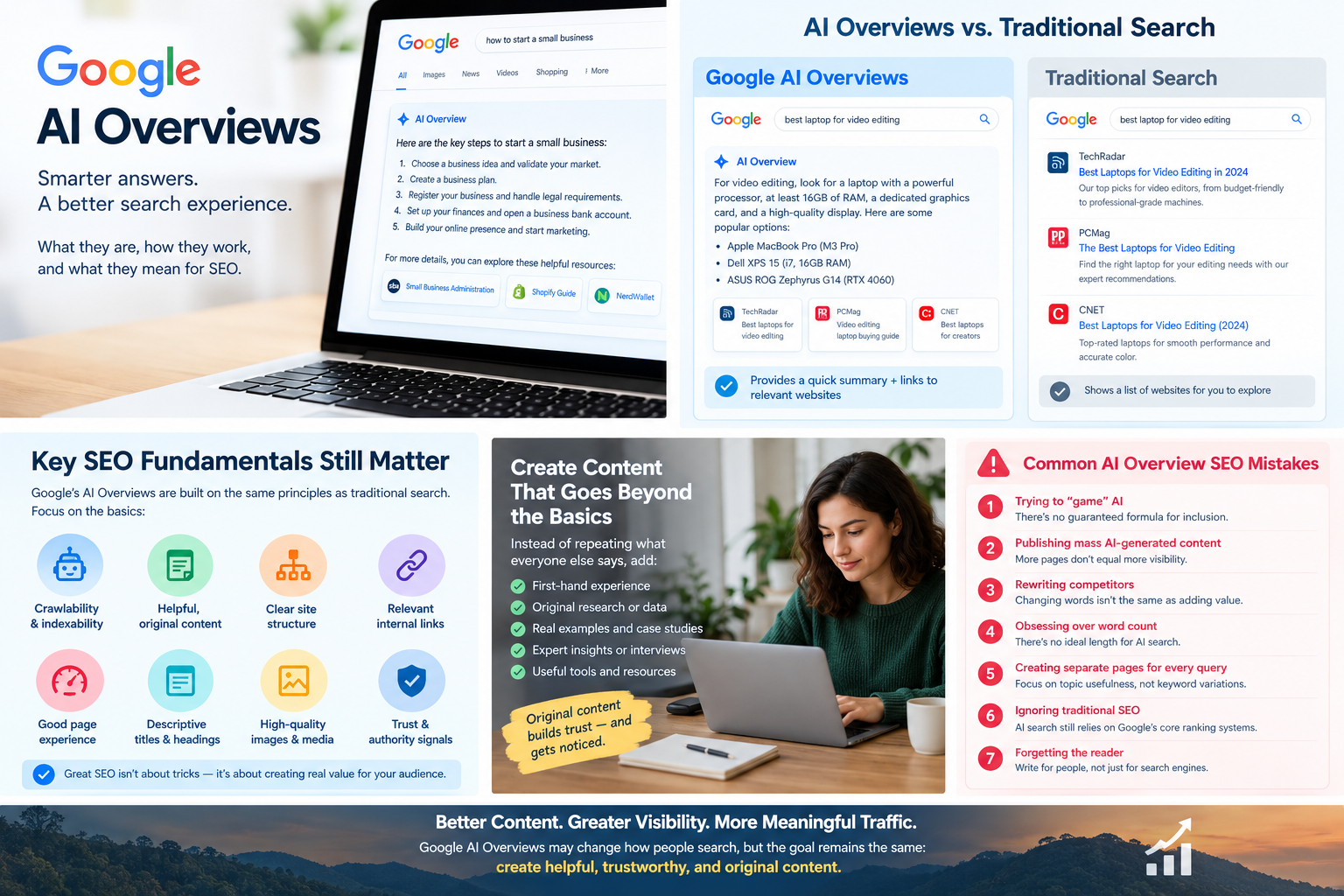
Google AI Overviews Google Search has changed dramatically over the past few years. For a long time, searching on Google meant typing a keyword, scanning a list of blue links, and opening several websites to piece together an answer.
That experience is becoming more conversational.
With Google AI Overviews, users can receive an AI-generated summary directly within Google Search, along with links to websites where they can explore the subject in greater detail. Instead of requiring users to visit multiple pages before understanding a topic, Google can summarize information from several sources and provide a starting point for deeper research.
This shift matters to website owners, bloggers, publishers, businesses, and SEO professionals because the traditional search results page is evolving.
However, there is an important misconception about AI Overviews: you do not need a completely separate “AI SEO” strategy to make your website eligible for them.
Google’s current guidance says that the fundamental principles of SEO still apply to AI Overviews and AI Mode. Websites should focus on technically accessible pages, helpful content, strong user experiences, originality, and information that genuinely satisfies the visitor.
So, what exactly are Google AI Overviews? How do they work? Can a website appear as a source? Does AI Overviews replace traditional SEO? And what should content creators do differently?
Let’s examine the answers.
What Are Google AI Overviews?
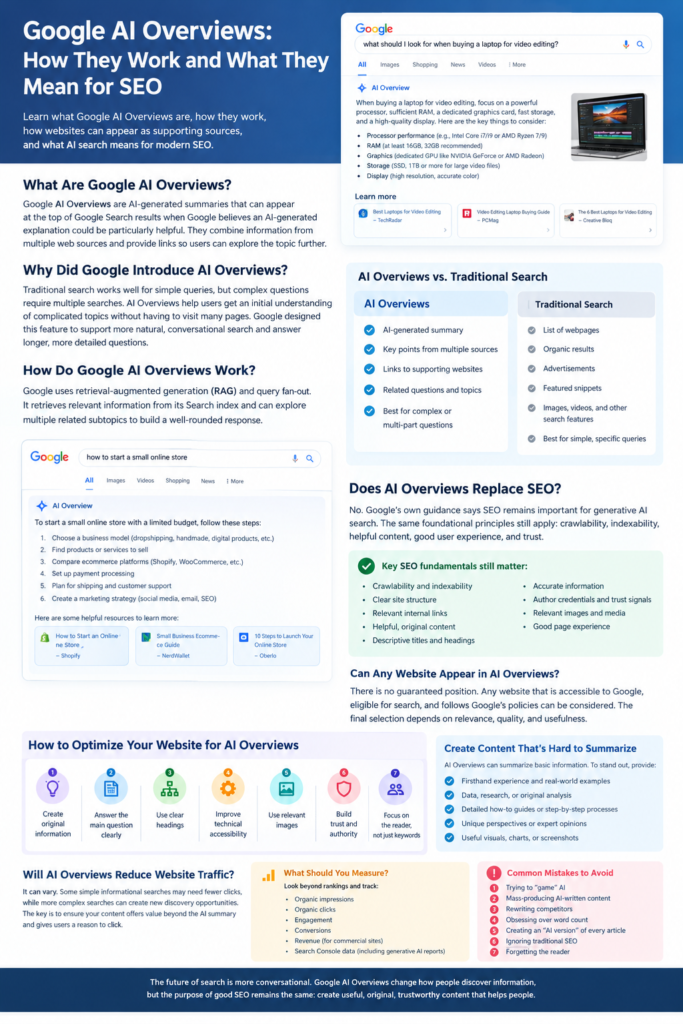
Google AI Overviews are AI-generated summaries that can appear at the top of Google Search results when Google’s systems determine that an AI-generated explanation could be particularly useful for the search.
The overview may combine information from multiple web sources and present the main points in a concise format. It can also provide links that allow users to visit supporting websites and investigate the topic further.
Google describes AI Overviews as a way to help people understand complicated subjects more quickly while still providing opportunities to explore information across the web.
For example, imagine someone searches:
“What should I look for when buying a laptop for video editing?”
Instead of only receiving a traditional list of webpages, Google may provide an AI-generated overview explaining important considerations such as:
- Processor performance
- RAM
- Graphics processing
- Storage
- Display quality
- Cooling
- Port selection
- Battery life
- Budget considerations
The overview can then point users toward websites containing more detailed information.
This means the search experience can move from:
Question → list of websites → research
toward:
Question → AI-generated overview → supporting websites → deeper research
The important point for publishers is that AI Overviews do not simply eliminate websites. Google says the feature includes prominent links to relevant webpages, giving users ways to continue exploring information on the web.
Why Did Google Introduce AI Overviews?
Traditional search works extremely well for many simple queries.
If someone searches for “weather Paris” or “YouTube,” they may want a quick result. But some questions are much harder.
Consider a search such as:
“How can I start a small online store with a limited budget while working a full-time job?”
Answering that question could require several searches:
- Choosing a business model
- Finding products
- Comparing ecommerce platforms
- Understanding payment processing
- Calculating startup costs
- Learning basic marketing
- Understanding shipping
- Planning customer support
AI Overviews are designed to help users get an initial understanding of more complicated questions without requiring them to perform every search separately.
Google has said that AI experiences are intended to make it easier to ask longer, more complex questions and explore topics through follow-up searches.
This is part of a larger change in search behavior.
People increasingly use natural-language questions instead of short keyword phrases. They may also ask questions involving comparisons, multiple conditions, images, or follow-up questions.
For content creators, that creates both challenges and opportunities.
How Do Google AI Overviews Work?
It is easy to assume that an AI Overview is simply a chatbot answer generated from an AI model’s memory.
That is not the best way to understand it.
Google explains that its AI search experiences are connected to its existing Search systems. AI features can retrieve relevant information from Google’s Search index and use that information to help construct responses.
Google’s documentation discusses two important concepts: retrieval-augmented generation (RAG) and query fan-out.
Retrieval-Augmented Generation
Retrieval-augmented generation, or RAG, involves retrieving relevant information from available sources and using that information to ground an AI-generated response.
In practical terms, this means Google’s AI systems can use relevant webpages from its Search index when developing an answer.
This is important for publishers because the quality and relevance of your webpage can still matter even when the user initially sees an AI-generated response rather than a conventional search snippet.
Query Fan-Out
Google also describes a technique called query fan-out.
Instead of treating a complicated question as one simple search, the system can generate multiple related searches around different aspects of the original question.
For example, suppose someone asks:
“What is the best way to improve a small business website’s conversions?”
A system could potentially explore related areas such as:
- Website usability
- Landing pages
- Mobile experience
- Page speed
- Trust signals
- Calls to action
- Product descriptions
- Customer reviews
- Analytics
The result can be a broader understanding of the subject.
Google says AI Overviews and AI Mode may use query fan-out to search across related subtopics and identify supporting webpages.
This is one reason simply targeting one exact keyword is becoming a less useful way to think about modern SEO.
AI Overviews vs. Traditional Google Search
AI Overviews and traditional search are related, but they provide different experiences.
Traditional Search
A conventional search generally provides:
- Search results
- Organic listings
- Advertisements
- Featured snippets
- Images
- Videos
- Other specialized search features
The user chooses which result to open.
AI Overviews
An AI Overview can provide:
- A generated explanation
- Several related concepts
- Supporting links
- Additional search opportunities
- A faster starting point for complex questions
The user may still click through to websites, but the first stage of the experience is different.
Google says AI Overviews are displayed when its systems determine that generative AI can be especially helpful for the query. They are not necessarily shown for every search.
That distinction is important.
You should not assume that every Google search will become an AI-generated answer.
Traditional organic search remains an important part of Google’s overall search experience.
Does AI Overviews Mean SEO Is Dead?
No.
In fact, Google’s own documentation explicitly says that SEO remains relevant for generative AI search.
Google’s AI features are rooted in its existing Search ranking and quality systems. The company recommends continuing to follow foundational SEO practices rather than trying to discover secret techniques specifically designed for AI Overviews.
That means website owners should continue focusing on fundamentals such as:
- Crawlability
- Indexability
- Helpful content
- Clear website structure
- Relevant internal links
- Good page experience
- Descriptive titles
- Useful headings
- Original information
- Accurate facts
- Strong authorship and trust signals
- Relevant images and media
The biggest change is not that SEO disappears.
The bigger change is that search visibility can happen through more formats than traditional rankings alone.
Can Any Website Appear in Google AI Overviews?
There is no guaranteed position in an AI Overview.
Google states that there are no additional technical requirements specifically required for appearing in AI Overviews or AI Mode beyond being eligible for Google Search with a snippet.
In other words, there is no official “AI Overview schema” that you can install and suddenly become a cited source.
A page needs to be:
- Accessible to Google
- Eligible to appear in Search
- Compliant with Google’s policies
- Useful and relevant
- High enough quality to be selected by Google’s systems
Meeting those requirements does not guarantee inclusion.
That is similar to traditional SEO.
Having a technically perfect webpage does not guarantee the number-one organic position.
The same principle applies to AI-generated search experiences.
What Makes Content More Useful for AI Search?
The most important lesson from Google’s guidance is surprisingly simple:
Create content that provides something genuinely useful to people.
Google’s current guidance encourages website owners to create unique, valuable, non-commodity content. It specifically highlights original viewpoints, firsthand experience, expert perspectives, useful organization, and high-quality images and video.
This is especially important because AI systems can summarize information that already exists.
If your article merely repeats the same basic information found on dozens of other websites, it may have little reason to stand out.
For example, consider two articles about starting a blog.
Generic article
“Choose a niche, buy a domain, create a website, write articles, promote your content, and make money.”
There is nothing particularly wrong with this advice.
But it is extremely common.
More useful article
A stronger article might explain:
- How the author selected a niche
- Which research methods worked
- Which content ideas failed
- How long it took to get traffic
- What the first 20 articles covered
- How internal linking was organized
- Which mistakes were expensive
- How conversion rates changed
- What the author would do differently
The second article provides information that is harder to reproduce because it contains experience, evidence, observations, and original analysis.
That is the kind of content that can provide value beyond a basic AI-generated summary.
First-Hand Experience Matters More Than Ever
One of the strongest ways to make a website valuable is to include information you actually know.
Suppose you are reviewing a pair of resistance bands.
A generic article might say:
“Resistance bands are portable, affordable, and useful for strength training.”
That’s true, but thousands of pages could say essentially the same thing.
A stronger review could explain:
- How the bands felt during actual workouts
- Whether the handles were comfortable
- Whether the bands slipped
- How the resistance compared with expectations
- What exercises worked best
- What type of user should avoid them
- How the product performed after several weeks
The difference is experience.
Google’s guidance specifically gives firsthand reviews as an example of content that can provide a unique perspective rather than simply repeating information already available online.
This principle applies to almost every niche.
Does Content Length Matter for AI Overviews?
There is no magic article length that guarantees visibility in AI Overviews.
Google explicitly says there is no ideal page length for generative AI search.
A page can be shorter or longer depending on what the audience needs. Google also says there is no requirement to break content into tiny sections simply to make it easier for AI systems to understand.
This is an important warning for SEO writers.
Do not write 3,000 words when 1,000 words completely answers the question.
And do not reduce a complicated subject to 500 words merely because you want a short article.
The right question is:
“How much information does my reader actually need?”
A comprehensive article should be comprehensive because the subject requires it, not because an SEO tool recommends a particular word count.
Should You Create Separate Pages for Every AI Search Query?
This is another common mistake.
Imagine you have an article about email marketing.
You might be tempted to create separate pages for:
- What is email marketing?
- What is email marketing strategy?
- How does email marketing work?
- How to do email marketing?
- Email marketing tips
- Email marketing guide
- Email marketing for beginners
- Email marketing basics
Some of these may deserve separate pages if they satisfy genuinely different user needs.
But creating dozens of near-identical pages simply to capture every possible variation can make a website worse rather than better.
Google’s generative AI optimization guidance warns against creating content primarily to manipulate rankings or AI responses and emphasizes serving user needs instead.
The goal should be topic usefulness, not keyword multiplication.
What About AEO and GEO?
You may have heard terms such as:
- AEO — Answer Engine Optimization
- GEO — Generative Engine Optimization
- AI SEO
- LLM SEO
These terms are increasingly used by marketers to describe optimization for AI-driven search experiences.
They can be useful labels for discussing changes in search behavior.
However, Google makes an important point: from Google’s perspective, optimizing for generative AI search is still fundamentally part of SEO.
Google recommends applying the same foundational SEO principles rather than chasing complicated “AI hacks.”
That means you should be skeptical of anyone promising:
“Use this secret AI Overview formula and Google will cite your website.”
There is no guaranteed formula like that.
How to Optimize Your Website for Google AI Overviews
Although there is no special AI Overview trick, you can make your website more useful and technically accessible.
1. Create Original Information
Do not simply rewrite the top-ranking pages.
Add something new.
That could be:
- Firsthand experience
- Original research
- Data
- Expert interviews
- Case studies
- Experiments
- Screenshots
- Comparisons
- Unique examples
- Lessons from mistakes
The goal is to give readers a reason to choose your page.
2. Answer the Main Question Clearly
Do not hide the answer beneath five paragraphs of introduction.
If the page is about “How does Google AI Overviews work?”, explain the basic answer early.
Then provide supporting detail.
This makes the article easier for humans to use and easier to navigate.
3. Use Clear Headings
Organize long content with descriptive headings.
For example:
- What Are Google AI Overviews?
- How Do AI Overviews Work?
- Does AI Overviews Replace SEO?
- How Can Websites Appear in AI Overviews?
- How to Create Content for AI Search
- Common AI SEO Mistakes
Good structure helps readers find what they need.
Google also recommends organizing content in a way that helps human readers navigate it.
4. Improve Technical Accessibility
Your best article cannot help users if Google cannot properly access it.
Check basics such as:
- Robots.txt configuration
- Indexing
- Canonical URLs
- Internal links
- Mobile usability
- Page performance
- JavaScript implementation
- HTTP status codes
- XML sitemaps
Google’s guidance recommends following normal crawling and technical SEO best practices for generative AI search.
5. Build Topic Depth Naturally
Instead of publishing dozens of thin pages, create useful content around the questions your audience genuinely has.
For example, a digital marketing website might have detailed resources covering:
- SEO
- Content marketing
- Email marketing
- Paid advertising
- Conversion optimization
- Analytics
- AI marketing
Each article should solve a meaningful problem rather than simply target a keyword.
6. Use Relevant Images
Images can make an article more useful and provide additional ways for your content to appear in search experiences.
Google’s current guidance recommends using high-quality, relevant images and video when they make sense for the page.
Do not add random stock photos just to make an article look longer.
A useful screenshot, original diagram, product photograph, chart, or explanatory graphic can be much more valuable.
7. Strengthen Trust
Make it clear who created the content.
Depending on the website, this may include:
- Author bylines
- Author biographies
- Editorial policies
- Sources
- Contact information
- About pages
- Firsthand experience
- Review methodology
- Updated information
Google’s people-first content guidance emphasizes clear authorship and trustworthy content.
Can AI-Generated Content Appear in Google Search?
Yes, AI can be used as part of the content creation process.
But that does not mean publishers should generate thousands of articles automatically and publish them without meaningful human review.
Google’s guidance says generative AI can be useful for research, organization, and other parts of content creation. However, producing large amounts of content without adding value may violate Google’s spam policies, particularly when the purpose is to manipulate Search rankings.
This creates an important distinction:
Using AI as a tool is not the same as using AI to mass-produce low-value pages.
For example, AI might help a writer:
- Brainstorm questions
- Create an outline
- Identify missing sections
- Improve readability
- Summarize research notes
- Suggest alternative explanations
- Check grammar
The writer still needs to verify facts, add original insights, edit the article, and ensure the final content genuinely helps the audience.
Why Generic AI Content Is a Problem
Imagine searching Google for:
“Best ways to improve website conversion rates.”
You may find hundreds of articles containing the same recommendations:
- Improve your CTA
- Make your website mobile-friendly
- Add testimonials
- Improve page speed
- Use A/B testing
- Create urgency
Again, none of these suggestions are necessarily wrong.
The problem is that they are predictable.
An excellent article might instead analyze a specific conversion problem and show what happened when a business tested different approaches.
For example:
A small ecommerce company noticed that visitors were reaching the checkout page but abandoning their carts. Instead of immediately offering a discount, the company watched user recordings and discovered that customers were confused by shipping information. After rewriting the shipping section and adding a delivery estimate, the company measured the change over several weeks.
That story provides a process.
It demonstrates observation, testing, and reasoning.
That is much more useful than another generic list of “10 conversion tips.”
Will AI Overviews Reduce Website Traffic?
This is one of the biggest concerns among publishers.
The honest answer is that the effect can vary by query, topic, website, search behavior, and how the AI experience is presented.
An AI-generated answer can potentially satisfy part of a user’s question without requiring a click.
At the same time, Google says AI Overviews include links to supporting webpages and that AI search experiences can help users discover a broader range of websites for complex questions. Google has also reported increased search usage for the types of queries that generate AI Overviews in major markets.
So the situation is more complicated than:
“AI Overviews kill traffic.”
A better way to think about it is:
Some simple informational searches may require fewer clicks, while more complex searches can create new discovery opportunities.
This makes the quality of the click increasingly important.
If someone clicks your website after seeing an AI Overview, your page needs to offer something valuable beyond the short summary they already received.
What Should Website Owners Measure?
Traditional SEO metrics remain useful, but website owners should think beyond rankings.
Track:
Organic impressions
Are your pages appearing in Google Search?
Organic clicks
Are users visiting your website?
Engagement
Do visitors actually interact with your content?
Conversions
Are visitors becoming:
- Customers?
- Subscribers?
- Leads?
- Members?
- Email subscribers?
Revenue
For commercial websites, traffic alone is not enough.
A page receiving 10,000 visitors but producing almost no revenue may be less valuable than a page receiving 1,000 highly relevant visitors that generates substantial sales.
Search Console Data
Google recommends using Search Console to monitor your website’s performance. Its current guidance also points website owners toward a Generative AI performance report for understanding performance in Google’s generative AI search experiences.
That makes measurement particularly important as search behavior evolves.
Common Google AI Overview SEO Mistakes
Mistake 1: Trying to “game” AI
There is no reliable formula that guarantees inclusion.
Focus on useful content instead.
Mistake 2: Publishing massive amounts of AI-written articles
More pages do not automatically mean more visibility.
Poor-quality content can create a worse website experience.
Mistake 3: Rewriting competitors
Changing words while keeping the same information does not necessarily create original value.
Mistake 4: Obsessing over word count
There is no universal ideal article length for AI search.
Mistake 5: Creating an “AI version” of every article
You do not need to rewrite every page into artificial, highly structured language for Google’s AI systems.
Google says its systems can understand synonyms and general meaning, so there is no need to write specifically for machines using unnatural keyword variations.
Mistake 6: Ignoring traditional SEO
AI search still depends on Google’s broader Search infrastructure.
Technical SEO, indexing, quality, relevance, and helpful content remain important.
Mistake 7: Forgetting the reader
This may be the biggest mistake.
If your article is written only because you want Google to cite it, you may be focusing on the wrong objective.
Write something a human would actually want to read.
A Practical AI Overview Content Strategy
If you run a blog or business website, you can adapt your content strategy without completely rebuilding your SEO process.
Start with five questions.
Question 1: What problem does the reader have?
Do not begin with the keyword.
Begin with the person.
Question 2: What does existing content fail to explain?
Read competing pages and identify missing information.
Question 3: What can you add from experience?
Look for:
- Examples
- Data
- Experiments
- Case studies
- Mistakes
- Screenshots
- Interviews
- Original opinions
Question 4: Can the article answer the main question quickly?
Give readers the basic answer early.
Then provide depth.
Question 5: What will make the reader remember your article?
This could be a useful framework, original research, a detailed example, or a practical checklist.
If readers remember your page after leaving it, you have probably created something more valuable than a generic SEO article.
The Future of Search Is More Conversational
AI Overviews are part of a broader transformation in how people interact with search engines.
Instead of searching:
“best laptop video editing”
a user may ask:
“I edit 4K videos, travel frequently, have a $1,500 budget, and need something lightweight. What should I prioritize?”
Instead of searching:
“content marketing tips”
a user may ask:
“I run a small local service business and have no marketing team. What content should I create each week?”
These questions contain more context.
They require search systems to understand relationships between multiple pieces of information.
Google’s AI Mode takes this even further by allowing users to ask more complex questions and continue the conversation through follow-ups. Google describes AI Mode as an experience designed for deeper exploration and reasoning, using techniques such as query fan-out to investigate multiple aspects of a question.
For website owners, this means content should become more useful, not merely more optimized.
What Google AI Overviews Mean for Small Websites
Small websites should not assume that AI search automatically favors enormous publishers.
A smaller website can have an advantage when it offers information that larger sites cannot easily reproduce.
For example:
- A local business can document its real projects.
- A photographer can share actual shooting experience.
- A fitness professional can explain a training method they use.
- A software developer can publish practical implementation lessons.
- An ecommerce business can document product testing.
- A consultant can publish anonymized case studies.
- A niche blogger can conduct original comparisons.
This kind of information creates a recognizable point of view.
Google’s guidance specifically encourages non-commodity content and firsthand perspectives because they provide value beyond information that could easily be generated or repeated elsewhere.
A Simple Checklist for AI Overview-Friendly Content
Before publishing an article, ask:
- Is the main question answered clearly?
- Does the article provide original value?
- Did I add information that is not simply copied from competitors?
- Are factual claims accurate?
- Are important claims supported by appropriate sources?
- Is the author clearly identified where appropriate?
- Does the article demonstrate experience or expertise?
- Are headings descriptive and useful?
- Are paragraphs easy to read?
- Are images genuinely relevant?
- Is the page technically accessible to Google?
- Does the article satisfy a real user need?
- Would I recommend this article to someone without considering SEO?
- Does the page provide enough depth for the topic?
- Have I avoided unnecessary repetition?
- Have I avoided creating content simply to target keyword variations?
If the answer to most of these questions is yes, you are approaching AI search in the right way.
Final Thoughts: Google AI Overviews Change Search, Not the Purpose of Good SEO
Google AI Overviews represent a major evolution in search.
Instead of always giving users a simple list of webpages, Google can now provide an AI-generated overview that brings together information and points users toward supporting sources.
That changes how people discover information.
But it does not change the fundamental reason a website succeeds.
Useful content still matters.
Original information still matters.
Trust still matters.
Technical accessibility still matters.
Good user experiences still matter.
Google’s current guidance is remarkably consistent on this point: website owners should continue using foundational SEO practices and focus on creating unique, valuable, people-first content rather than trying to exploit specialized AI-search tricks.
The biggest opportunity for publishers is therefore not to write content that sounds like an AI.
It is to create content that an AI-generated summary cannot fully replace.
A short AI Overview may explain the basics of a topic. Your website should give the reader the evidence, experience, examples, analysis, details, tools, and original perspective that make visiting your page worthwhile.
That is the real opportunity.
As search becomes more conversational, the websites most likely to remain valuable will not necessarily be the ones that publish the most content. They will be the ones that consistently answer meaningful questions better than generic alternatives.
So instead of asking:
“How can I trick Google AI Overviews into citing my website?”
ask a better question:
“What can I publish that gives my audience something genuinely useful that they cannot get from a generic summary?”
That shift in thinking is likely to produce a stronger website, better content, and a more sustainable SEO strategy—not only for Google AI Overviews, but for search as a whole.