

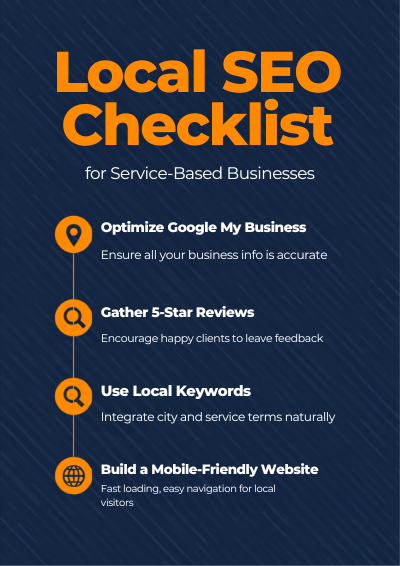
ocal SEO Checklist If you run a plumbing company, hair salon, law firm, HVAC business, cleaning company, dental practice, or any other service business tied to a geographic area, local SEO isn’t simply about getting your website to rank.
It’s about becoming the business a customer sees, trusts, and can contact when they need help.
A local search often happens at a very different stage of the buying journey from a general Google search. Someone looking for “emergency plumber near me” or “family lawyer in [city]” may already know what they need. They aren’t necessarily researching the industry. They’re deciding which business to call.
That makes local SEO a combination of visibility, credibility, relevance, and convenience.
Use the checklist below to find the gaps that could be costing your business local customers.
1. Build a Google Business Profile That Answers the Customer’s Questions
Your Google Business Profile is often the first detailed impression a potential customer gets of your business.
That means “claiming” the profile isn’t the finish line. It’s the beginning.
Your profile should make it immediately clear:
- What do you do?
- Where do you operate?
- When are you available?
- How can someone contact you?
- What services do you provide?
- What does your work actually look like?
At minimum, verify:
- Business name
- Primary business category
- Relevant secondary categories
- Address or service area
- Phone number
- Regular and holiday hours
- Website
- Services
- Business description
- Photos
- Attributes and other applicable profile details
Don’t add keywords to your business name simply because you think they’ll help rankings. Your business name should reflect the real-world name of the business.
And don’t treat the profile as a static listing. Update it when your hours, services, location, or business circumstances change.
The goal isn’t to make the profile look complete. It’s to make the profile useful enough that a customer doesn’t need to search elsewhere for basic information.
2. Treat Reviews as Both a Trust Signal and a Sales Asset
A potential customer comparing three plumbers, lawyers, salons, or contractors is rarely evaluating websites alone.
They’re looking at what other customers experienced.
That makes reviews valuable for two separate reasons: they can contribute to your local search presence, and they can influence whether someone chooses your business after finding it.
The important word is genuine.
Don’t buy reviews. Don’t create fake customer accounts. Don’t offer misleading incentives that violate platform rules.
Instead, build review requests into your normal customer process.
For example, after successfully completing a job:
Job completed → customer receives follow-up → review request → business responds
Make the request easy and timely.
And don’t respond to reviews with identical phrases such as “Thank you for your feedback!” every time. A specific response demonstrates that a real business is paying attention.
For negative reviews, avoid arguing publicly. Acknowledge the issue, provide an appropriate response, and move the conversation offline when necessary.
A review profile isn’t just a ranking asset. It’s part of your sales page.
3. Make Your Business Information Consistent—But Don’t Obsess Over Tiny Formatting Differences
NAP stands for Name, Address, and Phone number.
Your core business information should be accurate and consistent across your website, Google Business Profile, major directories, social profiles, and other legitimate business listings.
For example, don’t have one listing showing:
123 Main Street
and another showing:
987 Main Street
That is a real problem.
Minor formatting differences such as “St.” versus “Street” are generally far less important than having conflicting business information.
Local SEO Checklist for Service-Based Businesses
Fix the important inconsistencies first: wrong phone numbers, old addresses, duplicate listings, incorrect business names, and outdated hours.
Your goal is to make your business identity easy to understand across the web.
4. Create Location Pages That Prove You Actually Serve the Area
This is where many local SEO strategies become painfully repetitive.
A business creates one page for “Plumber in Dallas,” duplicates it four times, changes the city name, and calls it a location strategy.
That isn’t a strong local page.
If you genuinely serve several cities or neighborhoods, create useful location-specific pages—but give each page a reason to exist.
A strong location page might include:
- Services available in that area
- Specific neighborhoods or communities served
- Relevant service limitations
- Typical customer needs in that market
- Local project examples
- Directions or service information where appropriate
- Genuine testimonials from customers in the area
- Unique FAQs
- Relevant local details
For example, an HVAC company serving four towns could explain differences in service coverage, common seasonal problems, or completed projects in each market.
Don’t change the city name. Change the information.
That is the difference between a location page created for search engines and one created for customers.
5. Earn Local Mentions That Make Sense for Your Business
Not every directory on the internet deserves your attention.
A hundred low-quality listings aren’t automatically better than a handful of relevant, trustworthy references.
Prioritize places where your business genuinely belongs:
- Industry directories
- Professional associations
- Chamber of commerce listings
- Local business organizations
- Community organizations
- Local publications
- Relevant local websites
- Legitimate trade or professional directories
If a local newspaper covers a community project your company participated in, that’s more meaningful than submitting your business to dozens of obscure directories that nobody visits.
Think relevance first, volume second.
The best local references reinforce three things:
Who you are. Where you operate. What you do.
6. Stop Chasing “Near Me” Keywords and Build for Local Intent Instead
You don’t need to repeat “near me” twenty times across your website.
Google already understands that searches such as “dentist near me” or “emergency electrician” can have local intent.
Instead, make your website genuinely useful for someone looking for your service in a particular area.
Use natural language that answers questions such as:
- Do you serve my neighborhood?
- How quickly can you get here?
- Are you available today?
- What types of jobs do you handle?
- Do you work with residential or commercial customers?
- What areas do you cover?
- How can I contact you?
Voice search isn’t a magic SEO category that requires stuffing conversational phrases everywhere.
The better strategy is simpler:
Write pages that answer the questions a local customer would actually ask.
Local SEO Checklist for Service-Based Businesses
7. Make the Website Fast Enough for Someone Who Needs You Now
Local search often has a strong urgency component.
Someone searching for an emergency plumber isn’t interested in admiring your website design.
They want the phone number.
A person searching for a hair salon may want to check availability.
A homeowner comparing contractors wants to see previous work, service areas, reviews, and a way to request a quote.
Your website needs to make those actions obvious.
Check:
- Mobile usability
- Page loading performance
- Click-to-call functionality
- Navigation
- Contact forms
- Service pages
- Location information
- Appointment or quote requests
- Readability
- Prominent calls to action
Don’t make a customer hunt through three menus to discover whether you serve their area.
Local SEO gets someone to your website. Good UX gives them a reason to stay.
8. Use Structured Data to Clarify What Your Business Is
Search engines have to interpret your website.
Structured data gives them additional machine-readable information about entities and content on your pages.
Where appropriate, use relevant structured data to describe your business and other supported content accurately.
Depending on the business, that can include information such as:
- Business name
- Address
- Contact information
- Opening hours
- Services
- Geographic information
- Other applicable business details
But don’t treat schema markup as a ranking shortcut.
Adding structured data doesn’t magically push a weak business above stronger competitors.
Think of it as clarifying information that already exists, not manufacturing relevance.
And always make sure the structured data accurately represents visible or otherwise appropriate information on your site.
9. Publish Local Content That Has a Reason to Exist
“10 Things to Do in [City]” isn’t automatically local SEO.
Neither is writing 500 words about why your business is “the best service provider in [city].”
Local content becomes useful when the location genuinely changes the information.
For a roofing company, that might mean explaining weather-related maintenance issues common in its service area.
For a landscaping company, it could mean seasonal lawn-care guidance specific to the local climate.
For a law firm, it might mean explaining a genuinely local process or regulation.
For a home-services company, it could include real project stories from the communities it serves.
Local SEO Checklist for Service-Based Businesses
The test is simple:
Would this article still make sense if I removed the location name?
If the answer is yes, you may not have created truly local content.
10. Measure the Searches That Lead to Business, Not Just Rankings
Rankings are useful—but rankings aren’t the business.
A company can celebrate ranking #1 for a keyword that generates almost no customers.
Meanwhile, another page ranking lower might generate phone calls, quote requests, bookings, and revenue.
Track what happens after visibility.
Depending on your business, monitor:
- Google Business Profile interactions
- Calls
- Website visits from local searches
- Direction requests where relevant
- Form submissions
- Appointment requests
- Quote requests
- Organic conversions
- Branded versus non-branded search activity
- Performance of important service and location pages
Also watch competitors.
If another business repeatedly appears above you, don’t simply conclude that it has “better SEO.”
Look at what customers can see:
Does it have more recent reviews? Better service information? Stronger location relevance? More convincing photos? A clearer website? More useful pages?
Local SEO becomes much easier to improve when you stop treating rankings as the final metric.
The Local SEO Test That Matters Most
Before you worry about another keyword, search for your own business as if you were a customer who had never heard of you.
Then ask:
Can I tell what this business does within five seconds?
Can I tell whether it serves my area?
Can I see recent evidence that customers trust it?
Can I find its hours?
Can I contact it without hunting?
Does the website confirm what the search listing promised?
If the answer to several of these questions is no, you have a conversion problem hiding inside your SEO problem.
And fixing that can be more valuable than chasing another position in the rankings.
Real-World Example
Consider a family-owned HVAC company serving four nearby towns.
Its Google Business Profile hadn’t been meaningfully updated in more than a year. The listed hours were outdated, the photo collection was stale, and the business had accumulated only a small number of recent reviews.
Its website also had one generic service-area page instead of useful information for each market.
Rather than launching a massive SEO campaign, the company addressed the obvious gaps.
It updated its business information, improved its profile, began consistently requesting genuine reviews from customers, refreshed its photos, and created genuinely useful pages for the four areas it served.
Within roughly three months, the business reported an increase in calls originating from its Google presence.
The important lesson isn’t that every business will see the same result in three months.
It’s that local SEO doesn’t always require a complicated strategy to create meaningful improvement.
Sometimes the biggest opportunity is simply fixing the information customers and search engines are already trying to find.
Local SEO Checklist for Service-Based Businesses
User Experience: Local Searchers Don’t Want to Investigate Your Business
A local searcher is often impatient for a good reason.
They may need a plumber today.
They may be comparing dentists before booking.
They may be looking for a lawyer after a stressful event.
They may simply want to know whether a salon has an appointment available.
That means local search has a high-information, low-patience dynamic.
People want answers quickly:
Do you provide the service?
Do you serve my area?
Can I trust you?
Are you available?
How much effort will it take to contact you?
Every unanswered question creates friction.
That’s why local SEO shouldn’t be treated as a collection of technical tricks. Your search presence, website, reviews, photos, business information, and contact options all work together to answer the customer’s questions before they choose a competitor.
Frequently Asked Questions
How important are reviews for local SEO?
Reviews matter for two reasons: they can contribute to local search visibility, and they can strongly influence whether a potential customer chooses your business. Focus on earning genuine reviews consistently rather than trying to manufacture a high review count.
Do I need a separate page for every town I serve?
Not automatically. Create separate pages when the areas are genuinely important to your business and you can provide useful, unique information about serving them. Don’t create dozens of near-identical pages simply by swapping city names.
How long does local SEO take to work?
There is no universal timeline. Some improvements—such as correcting inaccurate business information or updating a profile—can have relatively quick effects. Competitive organic visibility and authority-building usually take longer and depend heavily on the market, competition, website quality, and existing reputation.
Is paid advertising a replacement for local SEO?
No. Paid advertising can provide immediate visibility while you’re building organic presence, but it works differently from local SEO. A strong strategy can use both: paid campaigns for immediate demand capture and SEO for longer-term visibility.
Should I focus on Google Business Profile or my website first?
Look at the weakness in your current customer journey. If your profile is incomplete or inaccurate, fix that first. If customers find you but then encounter a slow, confusing, or poorly targeted website, the website becomes the priority.
Local SEO Checklist: Priority vs. Effort
| Task | Priority | Effort | What You’re Trying to Improve |
|---|---|---|---|
| Complete and maintain Google Business Profile | High | Low–Medium | Visibility and customer confidence |
| Earn and respond to genuine reviews | High | Ongoing | Trust and local prominence |
| Correct important business-information inconsistencies | High | Low | Accuracy and entity consistency |
| Build genuinely useful location pages | High | Medium | Local relevance and conversions |
| Earn relevant local/industry listings | Medium | Medium | Authority and discoverability |
| Improve mobile UX and page performance | High | Medium | User experience and conversions |
| Add appropriate structured data | Medium | Medium | Search-engine understanding |
| Create genuinely local content | Medium | Ongoing | Relevance and topical coverage |
| Monitor local performance and conversions | High | Low–Medium | Decision-making |
| Review competitors regularly | Medium | Low | Finding gaps and opportunities |
Conclusion: Local SEO Rewards Businesses That Are Easy to Understand and Easy to Choose
Local SEO isn’t won by stuffing city names into pages or collecting hundreds of directory listings.
It is won by making your business consistently understandable, credible, relevant, and accessible wherever a local customer encounters it.
Your Google Business Profile should be accurate.
Your reviews should be genuine and current.
Your website should make your services and service areas obvious.
Your location pages should contain real information rather than duplicated city names.
Your business details should be accurate across important platforms.
And your measurement should go beyond rankings to determine whether local visibility is actually producing calls, leads, bookings, and customers.
Most competitors won’t execute all of these details consistently.
That is your opportunity.
Local SEO is ultimately a game of reducing uncertainty: the customer needs to know that you’re the right business, in the right place, offering the right service, and worth contacting.
When your online presence answers those questions better than the businesses around you, search visibility becomes more than a ranking.
It becomes a reason to choose you.
And that is the real foundation of a strong local search strategy.




[…] both, but the smartest approach is matching the tool to the actual problem rather than assuming more advanced technology is always the better […]