

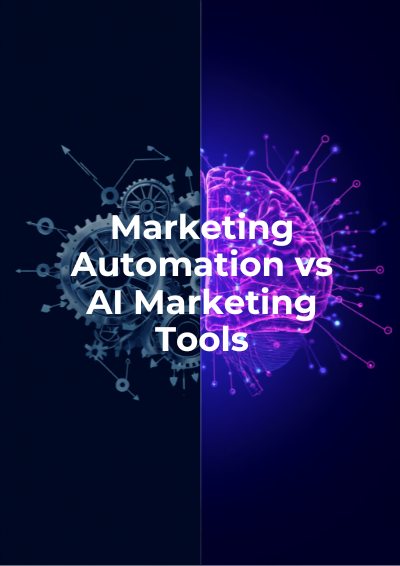
The Difference Between Marketing automation and AI marketing tools are often discussed as if they are the same thing.
They aren’t.
The confusion is understandable. Modern marketing platforms increasingly combine automation, machine learning, predictive analytics, and generative AI in the same product. A single platform might send an email automatically, predict which customer is most likely to buy, generate the email copy, and decide when that message should be delivered.
From the outside, all of that can look like “automation.”
Under the hood, however, the systems are doing very different things.
The simplest distinction is this:
Automation follows instructions. AI helps determine which instruction makes sense.
Understanding that difference matters because businesses can easily spend money on sophisticated AI capabilities when a straightforward automation workflow would solve the problem just as well.
At the same time, relying entirely on fixed rules can leave valuable opportunities on the table when a business has enough data to benefit from prediction and personalization.
The goal isn’t to choose the most advanced technology.
The goal is to use the right level of technology for the problem you’re trying to solve.
What Marketing Automation Actually Means
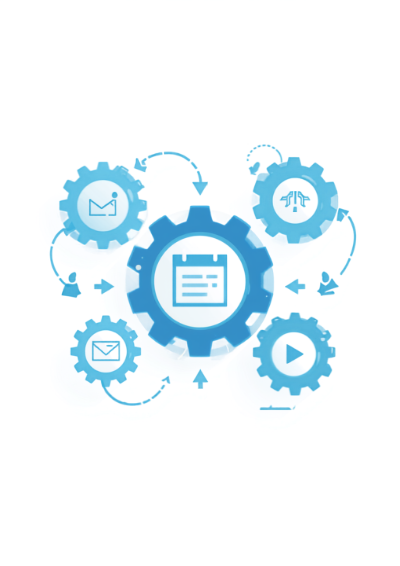
Marketing automation is software that performs predefined actions when specific conditions are met.
You establish the workflow.
The system executes it.
Classic examples include:
- Sending a welcome email when someone joins your mailing list
- Sending a reminder after a customer abandons a shopping cart
- Moving a lead into a different email sequence after they click a particular link
- Sending a follow-up message after someone downloads a resource
- Scheduling social media posts in advance
- Updating a customer’s status after they complete an action
The underlying logic is usually straightforward:
If X happens, do Y.
For example:
If someone subscribes to the newsletter, send the welcome email.
Or:
If someone abandons their cart, wait 24 hours and send a reminder.
The system doesn’t need to understand why the customer abandoned the cart.
It doesn’t need to predict whether the customer will return.
It simply executes the workflow that a marketer created.
The key advantage is consistency at scale.
Once a workflow is properly configured, the system can execute it thousands of times without someone manually triggering every action.
The important distinction is that traditional automation does not necessarily require the system to make a judgment.
It follows the rules you gave it.
What AI Marketing Tools Actually Do
AI marketing tools add a layer of analysis, prediction, generation, or decision-making to marketing workflows.
Instead of only asking:
“What should happen when this condition is met?”
AI can help answer:
“Given everything we know, what is most likely to work?”
Examples include:
- Generating personalized subject lines based on previous performance
- Predicting which leads are most likely to convert
- Recommending products based on customer behavior
- Generating draft ad copy or marketing content
- Analyzing sentiment across reviews and customer conversations
- Identifying patterns in customer behavior
- Predicting likely churn
- Adjusting advertising bids based on predicted performance
- Recommending the best time to contact individual customers
The important distinction is not that AI is simply “smarter automation.”
It is that AI can operate using patterns and probabilities derived from data rather than relying exclusively on rules explicitly written by a marketer.
For example:
A rule might say:
Send an email to every customer who abandons a cart.
An AI-powered system might instead estimate:
This customer has a 78% probability of returning without an incentive, while another customer has a 22% probability.
That difference creates the opportunity for a more selective strategy.
Automation Executes. AI Evaluates.
A useful way to think about the difference is to separate the marketing process into two questions:
Automation: What should happen?
The marketer defines the workflow.
AI: What is most likely to work?
The system uses data to help determine the best action, prediction, recommendation, or variation.
These technologies can work extremely well together.
In fact, many modern marketing systems combine both.
AI might decide which customers should receive a particular offer, while automation handles the actual delivery of that offer.
That creates a workflow like:
AI prediction → Automation → Customer response → New data → Better prediction
This combination is much more powerful than thinking about AI and automation as competing technologies.
Where Marketing Automation and AI Overlap
The line between the two is becoming increasingly blurred.
A modern marketing platform might contain:
- Rule-based workflows
- Predictive scoring
- Generative AI
- Personalization
- Automated segmentation
- Recommendation engines
- Performance optimization
For example, a marketer could create an automated email campaign that triggers after a customer performs a particular action.
AI could then determine:
- Which version of the email to show
- What subject line to use
- When to send it
- Which product to recommend
- How likely the customer is to convert
The workflow remains automated.
But the decisions inside that workflow become increasingly data-driven.
This is why simply asking whether a platform is “automation” or “AI” isn’t always enough.
A better question is:
Where does the intelligence enter the workflow?
A Simple Test: Could You Write the Logic on a Whiteboard?
Here’s a practical way to distinguish the two.
Ask:
“Could I write the exact decision-making logic on a whiteboard?”
If the answer is yes, you’re probably dealing with traditional automation.
For example:
Customer joins list → wait two days → send email → if they click → send product guide.
The logic is explicit.
You can see exactly why the system took each action.
If the system instead says:
“Based on thousands of previous customer interactions, this person is more likely to respond to version B at 7:30 PM.”
you are dealing with a predictive or AI-driven decision.
You may understand the factors influencing the prediction, but you generally aren’t writing every individual decision as a fixed rule.
That distinction is useful when evaluating marketing technology.
The Difference Between Marketing Automation and AI Marketing Tools
Which Does Your Business Actually Need?
The answer depends on your bottleneck.
Don’t start by asking:
“Where can we add AI?”
Start with:
“What problem are we trying to solve?”
If the problem is repetitive work, automation may be enough.
If the problem is deciding what to do with a large amount of customer data, AI may provide more value.
Choose automation-first when:
- Your team repeatedly performs the same manual tasks.
- Your workflows are predictable.
- The correct action is already known.
- Your biggest problem is operational efficiency.
- You need consistency more than prediction.
- You don’t have enough historical data for sophisticated modeling.
Consider AI-enhanced tools when:
- You have large volumes of customer or campaign data.
- Your team struggles to prioritize leads.
- Personalization is difficult to manage manually.
- Content creation has become a bottleneck.
- You need predictions rather than simple triggers.
- There are too many variables for practical rule-based decision-making.
AI isn’t automatically better.
If you only have a few hundred customers and a simple sales process, an elaborate predictive system may add complexity without producing meaningful benefits.
Technology should match the complexity of the problem.
A Practical Example: Cart Abandonment
Consider an online store with a large number of abandoned shopping carts.
A traditional automation workflow might look like this:
Cart abandoned → wait 24 hours → send reminder → offer discount.
Simple.
Predictable.
Easy to manage.
But there is a potential problem.
Some customers would have returned and purchased without the discount.
The business has therefore given away margin unnecessarily.
An AI-enhanced system could analyze historical behavior and estimate which customers are likely to purchase without an incentive.
The workflow could become:
Cart abandoned → evaluate customer behavior → predict purchase probability → choose appropriate message → automate delivery.
One customer might receive a simple reminder.
Another might receive product information.
Another might receive a limited incentive.
The difference isn’t that AI sends the email.
Automation can already do that.
The difference is that AI can help determine which action is most appropriate for each customer.
The Difference Between Marketing Automation and AI Marketing Tools
The Hidden Cost of Overusing AI
AI can sound impressive on a software pricing page.
But more sophisticated technology isn’t automatically more profitable.
Businesses should consider:
- Implementation costs
- Data requirements
- Integration complexity
- Accuracy
- Monitoring requirements
- Human oversight
- Training
- Subscription costs
- Potential errors
An AI system that produces slightly better predictions but requires significant implementation and management may be less valuable than a simple workflow that solves the problem reliably.
There is also an opportunity cost.
Every hour spent configuring unnecessary technology is an hour that could have been spent improving the customer experience, messaging, product, or strategy.
Don’t automate complexity simply because the technology makes it possible.
Data Quality Matters More Than AI Hype
AI-driven marketing decisions are only as useful as the information behind them.
If your customer data is incomplete, inconsistent, outdated, or poorly organized, adding AI doesn’t automatically solve the problem.
In some cases, it can make the problem harder to see.
Before investing heavily in predictive marketing technology, evaluate:
- How much historical data you have
- Whether the data is accurate
- Whether customer identities are properly connected
- Whether conversion events are tracked correctly
- Whether the data represents your current customers
- Whether there is enough volume to identify meaningful patterns
A new business with limited history may not benefit from sophisticated predictions immediately.
A mature business with years of clean behavioral data may have far more opportunities to use AI effectively.
Good AI starts with useful data.
Customer Experience Is Where the Difference Becomes Visible
Customers rarely care whether a marketing message was created by automation, AI, or a human marketer.
They care about the experience.
A rigid automated email can feel careless if it ignores what the customer has already done.
For example, imagine receiving a discount email for a product you purchased yesterday.
The system followed its rule.
But the experience is poor.
An adaptive system might recognize the purchase and change the message accordingly.
That could mean:
- Recommending a complementary product
- Providing setup instructions
- Asking for feedback
- Offering customer support
- Avoiding unnecessary promotional messages
The technology matters because it changes what the customer experiences.
Good marketing technology should make communication feel more relevant, not merely more automated.
The Difference Between Marketing Automation and AI Marketing Tools
Real-World Example
Imagine a mid-sized online retailer that has used marketing automation for several years.
Its cart-abandonment workflow sends the same discount offer to every customer 24 hours after an abandoned cart.
The system works reliably.
But it treats every customer the same.
The company introduces an AI-driven prediction model that estimates the likelihood that each customer will return and purchase without an incentive.
Instead of automatically discounting every abandoned cart, the business changes the workflow.
Customers predicted to have a high likelihood of returning receive a reminder without a discount.
Customers showing stronger signals that they need an additional incentive receive a targeted offer.
The automation still handles the execution.
AI influences the decision.
The result is a more sophisticated workflow that can potentially reduce unnecessary discounts while maintaining the campaign’s overall effectiveness.
The important lesson isn’t that every business needs this exact system.
It is that AI becomes valuable when a business has a decision that rules alone cannot handle efficiently.
The Best Marketing Systems Combine Both
The real choice isn’t always:
Automation OR AI
For many businesses, the better answer is:
Automation + AI
Automation provides the operational foundation.
AI can add prediction, personalization, prioritization, or content generation where those capabilities actually improve the outcome.
For example:
Customer action
↓
Automation records the event
↓
AI evaluates the customer
↓
Automation delivers the selected response
↓
Customer responds
↓
New data improves future decisions
This creates a system in which automation handles execution while AI supports decision-making.
Don’t Confuse AI Features With AI Strategy
One of the easiest mistakes businesses can make is buying a platform because it has an impressive list of AI features.
A tool can generate copy, predict scores, recommend audiences, and automate workflows.
But that doesn’t mean those features solve your most important marketing problems.
Before buying an AI marketing platform, ask:
- What decision are we trying to improve?
- What repetitive task are we trying to eliminate?
- Do we have enough data?
- How will we measure whether the AI actually improves results?
- What happens when the prediction is wrong?
- Where does human review remain necessary?
- Could a simpler automation solve the same problem?
These questions can prevent businesses from paying for technology they don’t actually need.
How to Choose Between Automation and AI
Use this simple framework.
If the process is predictable → Automate it.
If you already know what should happen, create a workflow.
If the decision depends on patterns → Consider AI.
If the right action changes based on customer behavior and historical data, predictive technology may help.
If the task requires creativity → Use AI as an assistant.
Generative AI can help produce drafts, variations, ideas, and summaries, but human review remains important.
If the data is poor → Fix the data first.
AI cannot compensate indefinitely for unreliable inputs.
If the process is high-risk → Keep humans involved.
The more consequential the decision, the more important oversight becomes.
Marketing Automation vs. AI Marketing Tools
| Factor | Marketing Automation | AI Marketing Tools |
|---|---|---|
| Core function | Executes predefined rules | Uses data to support predictions, recommendations, or generation |
| Decision process | Explicit and rule-based | Probabilistic or model-driven |
| Predictability | Highly predictable | Results can vary based on data and model behavior |
| Setup | Define workflow logic | Configure models, data, prompts, or AI features |
| Best for | Repetitive, predictable tasks | Prediction, personalization, prioritization, and generation |
| Data requirements | Often minimal | Usually greater for reliable predictive features |
| Example | Send a cart email after 24 hours | Predict which customers need an incentive |
| Human role | Designs and monitors workflows | Reviews strategy, outputs, predictions, and exceptions |
The distinction is not absolute.
Modern platforms increasingly combine both approaches.
But the table provides a useful starting point when evaluating marketing technology.
Frequently Asked Questions
Is AI marketing software too expensive for small businesses?
Not necessarily. Pricing varies considerably, and many marketing platforms now include AI features at different price points. The more important question is whether the feature solves a problem that is valuable enough to justify its cost.
Can I use marketing automation without AI?
Absolutely. Rule-based automation remains extremely useful for predictable workflows such as welcome sequences, reminders, lead routing, and follow-up campaigns.
Does AI marketing software replace a marketing team?
No. AI can reduce repetitive work and support analysis, content creation, and decision-making, but strategy, creativity, context, brand judgment, and accountability still require human involvement.
How much data do I need before AI becomes useful?
There is no universal threshold. It depends on the specific use case and technology. In general, predictive systems benefit from more relevant, accurate historical data. Businesses with very limited history may get more immediate value from straightforward automation.
Can automation and AI be used together?
Yes. In fact, combining them is often the most practical approach. AI can help determine what should happen, while automation handles when and how the action is executed.
The Bottom Line
Marketing automation and AI marketing tools aren’t competing versions of the same technology.
They solve different problems.
Automation is about execution.
It takes a known process and makes it happen consistently at scale.
AI is about intelligence applied to the process.
It can analyze patterns, generate content, make predictions, personalize experiences, and help determine which action is most likely to work.
The strongest marketing systems often use both.
Automation handles the repetitive plumbing.
AI helps improve the decisions flowing through that plumbing.
But businesses should resist the temptation to add AI simply because it is available.
If a simple rule can solve the problem reliably, automate it.
If the problem involves complex patterns, large amounts of data, or decisions that change from customer to customer, AI may provide additional value.
The smartest approach is not:
“How much AI can we add?”
It is:
“Where would intelligence actually improve the customer experience or business outcome?”
That question leads to better technology decisions—and often saves money in the process.
Automation and AI solve different problems — one handles repetition reliably, the other adds judgment based on data patterns. Most businesses eventually benefit from both, but the smartest approach is matching the tool to the actual problem rather than assuming more advanced technology is always the better choice.




[…] Track refund reasons or complaint themes after launch — they’ll tell you exactly where AI overreached, which is more useful than any general guideline. […]