

The Evolving Landscape of B2B Lead Generation in 2026
The world of B2B lead generation is constantly changing. What worked a few years ago might not be as effective today. In 2026, we’re seeing some significant shifts that are redefining how businesses connect with potential customers. It’s no longer just about individual campaigns; it’s about creating a connected system adsandscale.com.
One major change is the move towards integrated systems. Successful companies are combining outbound efforts (like cold emails) with inbound strategies (like content marketing) and using signals to create a single, powerful engine binaryflow.co. This means different parts of the lead generation process work together, rather than in isolation.
Another key trend is the emphasis on relevance and speed. Instead of trying to reach a huge number of people slowly, the focus is on quickly reaching fewer, highly interested accounts binaryflow.co. This ensures that efforts are directed towards those most likely to convert.
The role of Artificial Intelligence (AI) is also growing. AI tools are becoming crucial for tasks that used to be time-consuming, such as finding in-market accounts, enriching data, researching prospects, and scoring leads binaryflow.co. This frees up human teams to focus on building relationships and having meaningful conversations. We’re even seeing buyers use AI assistants like ChatGPT for recommendations, making answer engine optimization (AEO) a new and important channel for B2B lead generation binaryflow.co.
Furthermore, the quality of data is more important than ever. Outdated or massive lists can actually harm your efforts. The trend is towards fresh, verified, and enriched data that is built on demand, along with focusing on reliable first-party signals binaryflow.co.
Finally, we understand that B2B lead generation isn’t a one-step process. Leads move through different stages, and our job is to guide them, not push for a sale too early binaryflow.co. This means having a clear understanding of the buyer’s journey from awareness to decision.
Core Pillars of a High-Performing B2B Lead Generation System
To build a strong and predictable B2B lead generation pipeline, several key elements need to work together effectively adsandscale.com. Think of it as an engineered system with inputs, outputs, feedback loops, and continuous improvement adsandscale.com.
Defining Your Ideal Customer Profile (ICP)
The foundation of any successful B2B lead generation strategy is a sharply defined Ideal Customer Profile (ICP) adsandscale.com. This means knowing exactly who your best customers are, what problems they face, and why they would choose your solution binaryflow.co. When your ICP is clear, everything else, from messaging to channel selection, becomes much easier.
Strategic Channel Mix
Choosing the right channels is crucial for reaching your ICP. This mix should align with your deal size and how your buyers typically make purchasing decisions adsandscale.com. For most B2B teams, a combination of outbound and inbound channels is effective, with signals layered in binaryflow.co.
- Outbound channels (e.g., cold email, LinkedIn outreach) are great for generating near-term pipeline binaryflow.co.
- Inbound channels (e.g., content marketing, SEO, referrals) build over time and can lower costs in the long run binaryflow.co.
Content and Nurture Systems
Content plays a vital role in earning trust before a sales conversation even begins adsandscale.com. This includes various types of content tailored to different stages of the buyer’s journey:
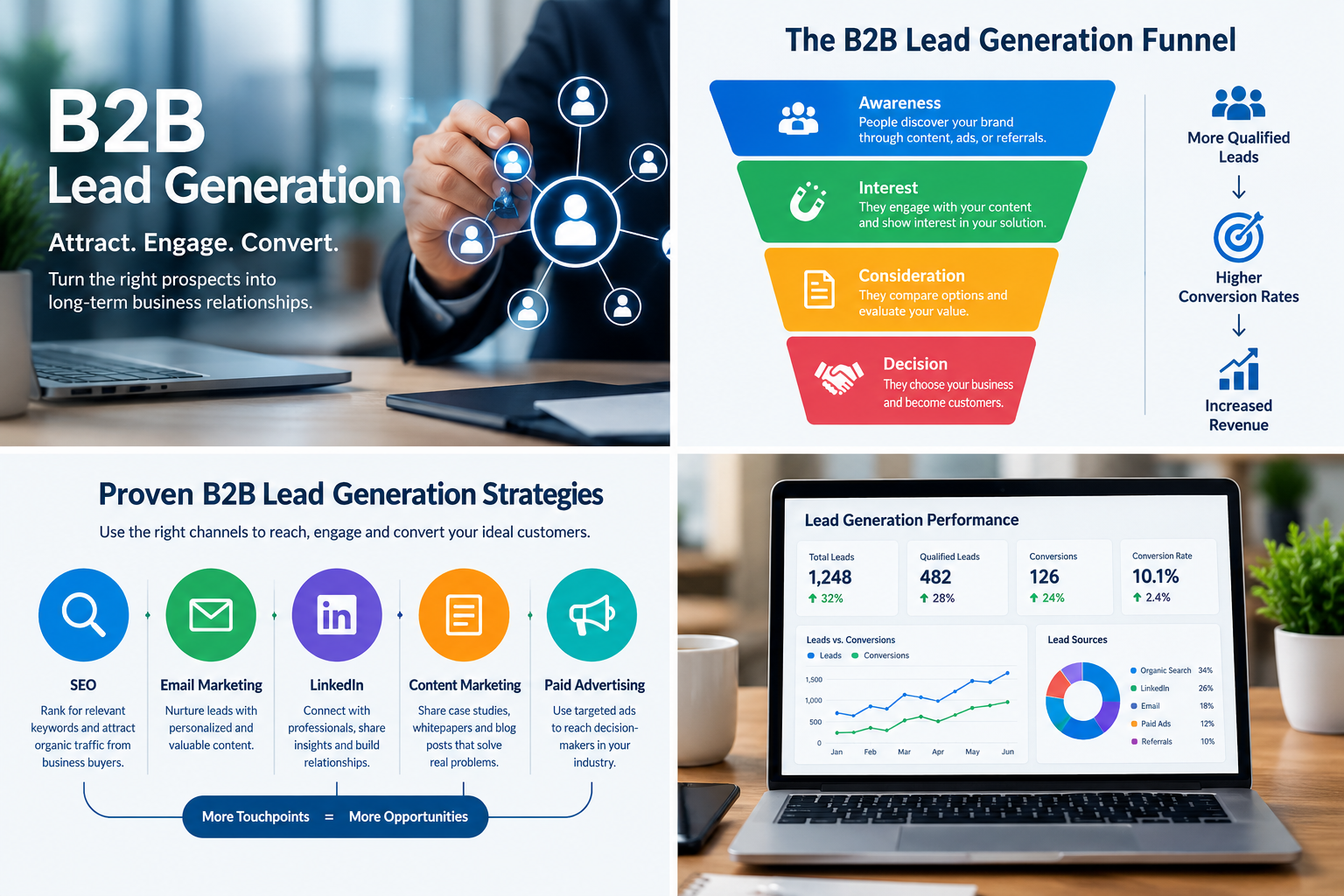
StageBuyer MindsetYour GoalTacticsAwarenessHas a problem, may not know solutionsEarn attention, build trustContent, SEO, AEO, LinkedIn, adsConsiderationComparing approaches and vendorsShow fit, capture the leadGuides, comparisons, case studies, lead magnets, retargetingDecisionReady to chooseMake it easy to actDemos, pricing, proof, fast follow-upbinaryflow.co
A robust nurture system is also essential to keep warm leads engaged throughout the often-long B2B sales cycle adsandscale.com. This ensures that leads don’t go cold while they are still considering their options.
Building a Repeatable B2B Lead Generation Process
Creating a repeatable B2B lead generation process involves a series of steps designed to consistently attract and convert targeted attention into qualified pipeline reachmarketing.com.
Step 1: Define Your ICP and Offer
As mentioned, this is the starting point. Get incredibly specific about your target audience and the compelling value you offer binaryflow.co. This clarity will streamline all subsequent efforts.
Step 2: Choose Your Channels Wisely
Don’t try to be everywhere at once. Select two or three channels where your buyers are most active binaryflow.co. For many B2B companies, this will involve a strong outbound strategy combined with content marketing and leveraging signals binaryflow.co.
Step 3: Set Up Capture and Tracking
Make sure your website is designed to convert visitors into leads. Implement visitor identification tools and connect your analytics to ensure no interested visitor is lost and you can measure what’s working binaryflow.co.
Step 4: Build Outbound and Inbound Motions
- Outbound: Establish a signal-driven outbound system for immediate pipeline needs. This involves proactively reaching out to prospects who show signs of being in-market binaryflow.co.
- Inbound: Start creating cornerstone content for long-term growth and brand authority. This content should address common pain points and questions of your ICP binaryflow.co.
Step 5: Qualify and Score Leads
Define what a qualified lead means for your business. Implement a system to score leads based on their fit with your ICP and their engagement behaviors. This helps ensure that sales teams focus on the most promising leads binaryflow.co. A well-calibrated MQL (Marketing Qualified Lead) definition typically sees an MQL-to-opportunity rate of 20-35% adsandscale.com.
Step 6: Fast Follow-Up and Nurture
Speed to lead is a critical factor in conversion binaryflow.co. Alert your sales team immediately for “hot” leads that require an instant human response. For leads that aren’t quite ready, implement nurture sequences to keep them engaged until their buying window opens binaryflow.co.
Step 7: Connect to CRM and Measure
Integrate all your lead generation activities with your Customer Relationship Management (CRM) system. This allows you to track leads through the entire funnel to pipeline and revenue, helping you identify any leaky stages binaryflow.co.
Step 8: Optimize and Double Down
Continuously review your data. Shift resources and effort towards the channels and segments that are generating real opportunities and pipeline. Don’t be afraid to cut channels that produce high volume but low pipeline contribution adsandscale.com.
Key Metrics and Continuous Optimization
Measurement is not guesswork; it’s essential for understanding and improving your B2B lead generation efforts leadriver.io. We need to track metrics across the entire funnel, from initial activity to revenue.
Top-of-Funnel Metrics
At the top, we track reach and response. This tells us how many of the right accounts we’re contacting and how many are engaging. These early indicators are crucial for determining if our targeting and messaging are effective before revenue figures are available leadriver.io.
Middle-of-Funnel Conversion Rates
In the middle, we focus on conversion rates between stages. This helps us identify where the engine might be leaking.
- Visitor → Lead: Average 2–3% reachmarketing.com
- Lead → MQL: Approximately 30% reachmarketing.com
- MQL → SQL (Sales Qualified Lead): Approximately 10–15% reachmarketing.com
- SQL → Opportunity: 30–50% reachmarketing.com
- Opportunity → Customer: 20–30% reachmarketing.com
If a team gets many responses but few opportunities, it might signal a qualification problem. If conversion rates are strong but there aren’t enough responses, the issue could be with reach leadriver.io.
Bottom-Line Revenue Metrics
Ultimately, we connect all activity to revenue. Key metrics include:
- Cost Per Lead (CPL) by channel: This shows what you’re paying for each lead from different sources. LinkedIn CPL might be higher ($80-$200) than Google Search ($30-$100), but lead quality often compensates adsandscale.com.
- Cost Per Acquired Customer (CAC) by channel: This is the ultimate metric, linking marketing spend directly to revenue. We look for improving CAC over time in paid channels and declining CAC in content as organic volume grows adsandscale.com.
- Pipeline Velocity: This single number captures the health of your entire revenue engine. It’s calculated as (Number of opportunities × average deal size × win rate) / average sales cycle in days adsandscale.com.
- Lead-to-Opportunity Rate: How well leads convert into actual sales opportunities; a key indicator of lead quality binaryflow.co.
- Opportunity-to-Close Rate: Of opportunities created, how many actually close. A 20-30% rate is a reasonable baseline for mid-market B2B adsandscale.com.
Continuous Optimization
B2B lead generation systems require constant optimization. Static strategies quickly become ineffective as markets, competition, and buyer expectations change reachmarketing.com. This involves:
- Testing messaging and positioning reachmarketing.com
- Refining targeting criteria reachmarketing.com
- Improving conversion pathways reachmarketing.com
- Adjusting channel allocation based on performance reachmarketing.com
By iterating on data, we can improve unit economics over time, making our lead generation efforts more efficient and effective adsandscale.com.
FAQ: B2B Lead Generation in 2026
Q: What is a good B2B lead conversion rate in 2026? A: A strong B2B conversion rate typically ranges from 3% to 5%, with top-performing programs potentially exceeding 8% depending on the specific context reachmarketing.com.
Q: How has AI impacted B2B lead generation? A: AI significantly helps with the less glamorous but crucial tasks like finding in-market accounts, enriching data, researching prospects, and scoring leads. It allows humans to focus on the offer and conversation. Additionally, optimizing for AI assistants (answer engine optimization) is becoming a vital new channel binaryflow.co.
Q: Why is “speed to lead” so important? A: Speed to lead is a direct driver of conversion. Rapid follow-up on hot leads significantly increases the chances of moving them further down the sales funnel binaryflow.co.
Q: What is the most important metric for B2B lead generation? A: While many metrics are important, tracking pipeline and revenue is paramount. A cheap lead that never closes is ultimately expensive. The goal is qualified pipeline that turns into revenue, not just form fills binaryflow.co. Metrics like Customer Acquisition Cost (CAC) and Pipeline Velocity are also crucial for understanding overall efficiency and health cleverly.co, adsandscale.com.
Conclusion: Building a Sustainable B2B Lead Pipeline for the Future
In 2026, B2B lead generation is less about isolated campaigns and more about building a cohesive, engineered system. The companies that succeed are those that start with an operationalized ICP, match their channel mix to their deal size, create nurture programs that cover the entire sales cycle, and rigorously measure metrics that directly link activity to revenue adsandscale.com.
The compounding effect of quality content and strong brand authority will increasingly differentiate programs that plateau from those that achieve continuous pipeline growth without proportional increases in spending adsandscale.com. By embracing these principles and continuously optimizing based on data, we can build robust and sustainable B2B lead generation engines that drive predictable revenue for years to come.