

Content marketing has become an important part of how businesses attract customers, build trust, and compete online. Instead of relying entirely on advertisements, companies can educate their audiences through helpful articles, videos, email newsletters, research reports, and other useful resources. However, producing content consistently does not automatically lead to better marketing results. Businesses also need a clear strategy, a strong understanding of their audience, and a reliable way to measure performance.
This is where the Content Marketing Institute (CMI) becomes a valuable resource for marketers, entrepreneurs, agencies, and content creators.
The Content Marketing Institute provides educational resources, expert insights, industry research, and professional events designed to advance content-driven marketing. Its website helps marketers understand the principles behind effective content strategies and apply them to real business challenges. According to its official website, CMI supports organizations ranging from small businesses to large enterprises through education, research, and professional development.
Whether you are starting a blog, managing a business website, generating B2B leads, or building a long-term digital marketing strategy, understanding the resources available through CMI can help you make more informed decisions.
This guide explains what the Content Marketing Institute is, what it offers, how content marketing works, and how businesses can use its educational resources to create more useful content and achieve measurable results.
What Is the Content Marketing Institute?
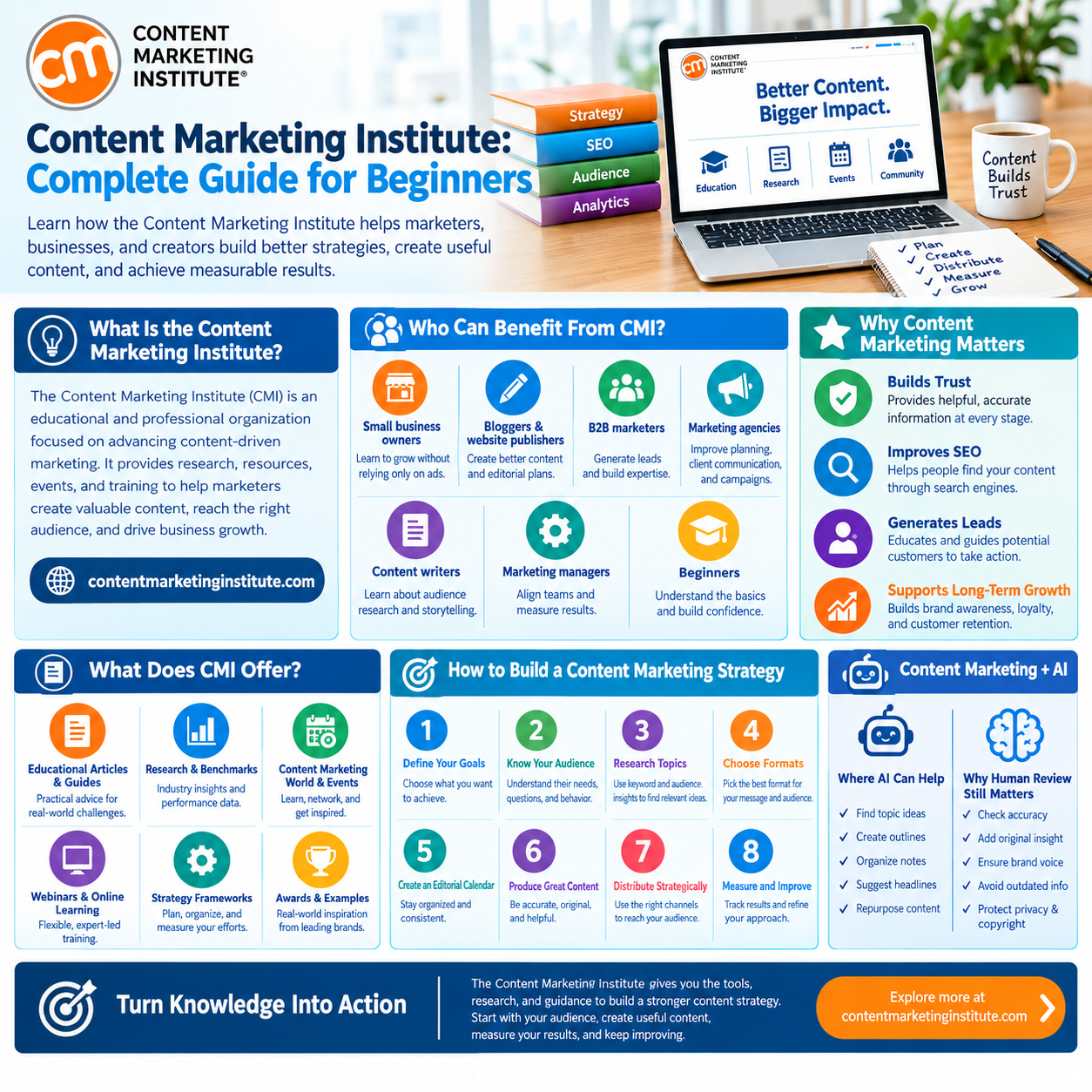
The Content Marketing Institute is an educational and professional organization focused on improving the practice of content marketing. Its mission is to help marketers and organizations understand how to use valuable, relevant content to attract and retain audiences.
Rather than treating content as a collection of unrelated blog posts or social media updates, CMI promotes a strategic approach. This means connecting content creation with audience needs, business objectives, distribution channels, and performance measurement.
The organization was founded in 2011 and later became part of Informa. Its website publishes practical advice, industry commentary, research, case studies, and educational material for marketing professionals.
You can explore its official resources at Content Marketing Institute.
Why Was the Content Marketing Institute Created?
Businesses frequently produce marketing materials without defining what those materials should accomplish. A company might publish several articles every month, send promotional emails, and maintain multiple social media accounts without knowing whether these activities attract suitable customers.
Content marketing requires more than frequent publishing. It involves understanding the audience, identifying the questions people need answered, and delivering information that helps them make decisions.
CMI helps address this challenge by educating marketers about strategy, storytelling, audience development, content operations, and measurement.
For example, a software company could publish an article explaining how to choose project management software. A consulting business might create a detailed guide to reducing operating costs. An online retailer could develop a product comparison that helps shoppers understand which option suits their needs.
Each example serves an audience need while supporting a business objective.
Who Can Benefit From CMI?
The Content Marketing Institute offers resources that can be useful to different types of professionals, including:
- Small business owners: Learn how to promote products and services without depending exclusively on paid advertising.
- Bloggers and website publishers: Develop stronger editorial plans and create articles that answer readers’ questions.
- B2B marketers: Educate business buyers, nurture leads, and communicate expertise.
- Marketing agencies: Improve content planning, client communication, and campaign execution.
- Content writers: Understand audience research, editorial standards, storytelling, and content strategy.
- Marketing managers: Coordinate teams, allocate resources, and connect content activities with organizational goals.
- Beginners: Learn the foundations of content marketing before investing in complicated tools or large campaigns.
The most useful starting point depends on your goals. Someone learning the basics needs different resources from a marketing director managing a large content team.
What Does the Content Marketing Institute Offer?
CMI provides several types of educational and professional resources. Understanding the purpose of each can help you select material that addresses your specific challenges.
1. Educational Articles and Practical Guides
The CMI website publishes articles covering content strategy, editorial planning, audience development, distribution, analytics, and related marketing topics.
These resources can help readers move beyond general advice and understand how marketing decisions affect their work.
For example, a beginner might learn how to establish a content marketing strategy before publishing a series of articles. An experienced marketer might investigate ways to improve content distribution or communicate campaign results to company leadership.
A practical way to use these articles is to begin with a specific problem. If your website attracts visitors but receives few inquiries, look for guidance about audience intent, conversion paths, and calls to action rather than reading unrelated marketing material.
You can explore the official CMI website to find its latest educational resources.
2. Content Marketing Research and Industry Benchmarks
Research is one of the important resources associated with the Content Marketing Institute.
Its annual research examines how marketers approach content creation, budgets, distribution, strategy, performance measurement, and emerging technologies. Some studies focus specifically on business-to-business marketing.
These findings help marketers compare their practices with those of surveyed professionals and identify areas that deserve further investigation.
For instance, CMI’s B2B Content Marketing Benchmarks, Budgets, and Trends: Outlook for 2025, conducted with MarketingProfs, surveyed 980 B2B marketers. The report found that 58% described their content marketing strategy as moderately effective. Respondents also identified challenges involving resources, clear goals, measurement, and alignment with the buyer journey.
These findings illustrate a practical lesson: having a content strategy does not guarantee that it will perform well.
However, survey statistics should be interpreted carefully. Results reflect the respondents, questions, and period covered by each study. They do not guarantee that an individual business will experience the same outcomes.
When using CMI research, examine the publication date, sample, methodology, and exact wording of the findings. Avoid presenting an older forecast as if it describes current market conditions.
3. Content Marketing World and Professional Events
CMI also organizes professional events, including Content Marketing World, which brings together marketers, strategists, creators, and industry specialists.
Such events can provide opportunities to learn about content planning, storytelling, audience engagement, leadership, technology, and performance measurement.
Events may be especially useful for professionals who want to compare experiences with other marketers or learn how larger organizations approach complex content operations.
However, attending an event is not automatically a solution to a marketing problem. The value depends on the relevance of the sessions, the quality of the learning, and whether participants apply useful ideas afterward.
Before paying for a conference, review the agenda, speakers, learning objectives, and total cost. Smaller businesses may achieve similar initial learning goals through free articles, webinars, and publicly available research.
4. Webinars and Online Learning
Webinars and digital educational resources allow marketers to learn without necessarily traveling to an in-person event.
They can be helpful when a team needs an introduction to a particular topic or wants to understand a new approach before investing time and money in implementation.
For example, a marketing team exploring artificial intelligence could use educational sessions to discuss content workflows, human review, brand consistency, and the limitations of automated tools.
After watching a webinar, record the two or three ideas most relevant to your organization. Then test one idea in a small project instead of attempting to change every marketing process at once.
5. Content Marketing Frameworks and Strategy Resources
CMI publishes resources that help marketers structure their content marketing programs.
A framework can be useful because it turns an abstract goal, such as building brand awareness, into a series of manageable decisions.
These decisions may include defining the audience, establishing a business purpose, choosing suitable content formats, planning distribution, and determining how results will be evaluated.
The important point is not to copy a framework mechanically. Instead, adapt its principles to your business, available resources, customers, and competitive environment.
6. Content Marketing Awards
The Content Marketing Institute has also been associated with the Content Marketing Awards, which recognize work in the content marketing industry.
Awards and professional examples can provide inspiration by showing how organizations approach storytelling, design, editorial planning, and audience engagement.
Nevertheless, an award-winning campaign is not necessarily the right model for every business. A campaign created for a multinational brand may require resources that a small company does not have.
Use examples to understand the underlying principles rather than reproduce their appearance or tactics without considering your own audience.
What Is Content Marketing, and Why Does It Matter?
Content marketing is a strategic marketing approach that involves creating and distributing valuable, relevant content for a clearly defined audience to achieve a business objective.
Its purpose is different from simply publishing promotional messages. Good content helps people understand a problem, compare alternatives, learn a skill, or make a better decision.
Consider a small company that sells accounting software. It could repeatedly advertise its product, or it could publish a guide explaining how freelancers can organize invoices, track expenses, and prepare for tax season.
The guide helps readers understand a practical problem. Readers who need accounting software may subsequently explore the company’s product.
The content does not guarantee a sale, but it gives the business an opportunity to build credibility and reach people who are already interested in the subject.
Building Trust With Useful Information
Customers often investigate products and services before contacting a company. Helpful content can answer early questions and reduce uncertainty.
A business that explains its process, limitations, pricing considerations, and common customer problems may give potential buyers a clearer understanding of what to expect.
Trust is not created by making unsupported claims or publishing endless promotional articles. It develops when the information is accurate, transparent, consistent, and genuinely useful.
Supporting Search Engine Visibility
Search engines can help people discover articles, guides, comparisons, and other resources when they search for relevant information.
Content that answers a real question clearly may attract organic traffic over time. However, publishing more pages does not automatically improve search performance.
A useful article should match the reader’s intent, provide information that is difficult to obtain from a superficial summary, and present that information in an accessible structure.
For example, someone searching for “how to create a B2B content strategy” probably needs a practical explanation of audience research, business goals, content planning, and measurement. A page that merely repeats the phrase several times will not adequately satisfy that need.
Generating Leads and Supporting Sales
Content can also support lead generation by helping potential customers understand a business’s expertise.
A consulting firm might publish an in-depth guide and offer a related checklist in exchange for an email subscription. A software company might create a case study showing how a customer approached a particular operational challenge.
These resources can help potential buyers evaluate whether a company’s experience is relevant to their needs.
The key is to provide a logical next step. A useful guide might invite readers to download a related template, explore a detailed case study, or request a consultation.
The offer should relate directly to the content rather than interrupt the reader with an unrelated promotion.
How to Build a Content Marketing Strategy
A successful content marketing strategy begins with decisions about purpose and audience. Publishing should follow those decisions, not replace them.
Step 1: Define Your Business Goals
Start by identifying what you want content marketing to accomplish.
Possible goals include:
- Increasing qualified website traffic.
- Generating relevant sales leads.
- Educating potential customers.
- Improving customer retention.
- Building recognition in a specialized market.
- Helping existing customers use a product more effectively.
Choose a primary objective before selecting content formats.
For example, a new business may prioritize attracting relevant visitors, while an established software company may focus on helping prospective customers compare solutions.
Clear objectives make it easier to decide what to publish and which results matter.
Step 2: Understand Your Target Audience
Audience research should help you understand who your readers are, what they need, and how they make decisions.
Useful sources include customer interviews, sales conversations, support requests, search queries, website analytics, product reviews, and frequently asked questions.
Imagine that you operate a digital marketing agency and notice that several prospects ask why their websites receive traffic but generate few inquiries.
That recurring question could inspire an article explaining the relationship between search intent, landing-page messaging, trust signals, and conversion paths.
This is more useful than selecting a topic solely because a keyword tool reports a large search volume.
Create a basic audience profile that identifies:
- The people you want to reach.
- Their most important problems.
- The questions they ask before buying.
- Their existing knowledge of the subject.
- The information they need to take the next step.
Avoid assuming that every person in a broad demographic group has the same needs. Actual customer evidence is more useful than stereotypes.
Step 3: Research Topics and Search Intent
Keyword research can help identify how people describe their problems online. It can also reveal related questions and opportunities to create useful resources.
However, keyword research should inform your editorial decisions rather than determine every decision.
Suppose your target phrase is “content marketing strategy.” Related topics could include audience research, editorial calendars, content distribution, performance measurement, and content repurposing.
Instead of producing many short pages that repeat similar information, consider building a comprehensive guide and supporting it with more specific articles.
Before choosing a topic, ask:
- Does it relate to my audience?
- Can I provide a useful and accurate answer?
- Does it support my website’s main subject?
- Can I add examples, analysis, or practical guidance?
- Is there a clear reason for readers to visit this page instead of another page on my website?
These questions help prioritize quality and relevance.
Step 4: Choose Appropriate Content Formats
Different formats serve different purposes.
Blog articles explain topics in detail and can attract search traffic.
Videos demonstrate processes, explain visual concepts, and communicate personality.
Email newsletters help businesses maintain relationships with people who have chosen to subscribe.
Case studies describe a customer’s challenge, the approach taken, and the results that can be supported by evidence.
Research reports organize data and analysis for readers who need deeper insight.
Infographics summarize information visually when relationships or comparisons are easier to understand at a glance.
Webinars provide opportunities for teaching, demonstrations, and questions.
Do not choose a format simply because it is popular. Consider your audience’s preferences, the complexity of the topic, your production capabilities, and the outcome you want.
A plumbing company might benefit more from short videos demonstrating common maintenance issues than from publishing lengthy industry reports. A B2B technology firm may need detailed implementation guides and technical documentation.
The best format is the one that communicates the information effectively to the intended audience.
Step 5: Create an Editorial Calendar
An editorial calendar helps organize content production so that publishing does not depend entirely on last-minute ideas.
Your calendar can include the topic, target audience, search intent, format, author, publication date, review status, distribution channels, and primary objective.
For a small website, a spreadsheet may be sufficient. A larger organization might need project management or content operations software.
A realistic calendar is more valuable than an ambitious schedule that cannot be maintained.
For example, a small business might begin with two well-researched articles per month, one email newsletter, and several useful social media updates derived from the published material.
As the workflow becomes more reliable, the business can increase production where there is a clear reason to do so.
Step 6: Create Original, Helpful Content
Original content does not necessarily mean discovering something nobody has ever discussed. It means providing genuine value through your research, explanation, experience, analysis, examples, or presentation.
Before drafting an article, identify what readers should understand by the end.
Support factual claims with credible sources. Explain unfamiliar concepts. Include practical steps and relevant examples. Distinguish verified findings from assumptions or opinions.
If you use a hypothetical example, make it clear that it is illustrative. If you describe an actual business result, use evidence that supports the figures and circumstances.
Avoid inventing customer testimonials, personal experiences, survey results, or case studies to make an article appear more authoritative.
A smaller article with a clear answer and accurate information can be more useful than a long article filled with repetition.
Step 7: Distribute Your Content
Publishing is only one part of content marketing. The next challenge is helping the intended audience discover the material.
Depending on the topic and audience, distribution may include:
- Search engine optimization.
- Email newsletters.
- Relevant social media communities.
- Professional networks.
- Partnerships with complementary businesses.
- Webinars and industry events.
- Links from other useful resources on your website.
Distribution should fit the audience rather than rely on posting everywhere.
For example, a B2B guide aimed at business executives might perform better through a targeted professional newsletter and relevant LinkedIn discussions than through a broad campaign on an unrelated entertainment platform.
Always respect platform rules, email consent requirements, and the expectations of the communities you join.
Step 8: Measure Results and Improve
A content strategy should change when the evidence shows that a different approach may work better.
Track performance according to the original goal. If your objective is awareness, relevant reach and qualified visits may matter. If your objective is lead generation, you may need to track form submissions, qualified inquiries, and subsequent sales activity.
Use the findings to identify what deserves improvement.
An article with strong impressions but few clicks might need a clearer title or a better match with search intent. An article with many visitors but few inquiries might need more relevant next steps or a stronger explanation of the service.
Do not assume that every underperforming page needs to be rewritten completely. First investigate the available evidence and identify the most plausible problem.
Content Marketing Institute and the Role of Artificial Intelligence
Artificial intelligence has introduced new ways to research, organize, draft, summarize, and improve marketing content.
AI tools can help generate topic ideas, outline articles, organize interview notes, suggest alternative headlines, and adapt material for different channels.
These capabilities can save time, particularly for small teams with limited resources. However, faster production does not automatically create better marketing.
Where AI Can Help
A marketer might use AI to group hundreds of customer questions into recurring themes. Another might use it to create an initial outline from verified research notes.
An editorial team could also use AI to identify unclear sentences, generate alternative descriptions, or produce a first draft of a routine internal document.
In each case, the tool supports a defined task rather than replacing the entire content strategy.
Why Human Review Still Matters
AI-generated material can contain inaccurate statements, outdated information, generic recommendations, or details that sound convincing without being supported by evidence.
It may also produce writing that resembles thousands of existing articles without offering a meaningful reason for readers to choose it.
Human reviewers should verify important claims, assess relevance, add original insight, check examples, and ensure that the final material reflects the organization’s standards.
Businesses should also consider privacy, copyright, confidentiality, and disclosure obligations when using AI tools.
A sensible workflow is to use AI for assistance, subject-matter experts for accuracy, and editorial judgment for quality and audience relevance.
The objective is not to publish the greatest possible number of AI-assisted pages. It is to help readers more effectively while supporting a legitimate business purpose.
Common Content Marketing Mistakes to Avoid
Even organizations that invest significant time in content can struggle when their approach lacks focus.
Publishing Without a Clear Purpose
An article may receive attention without contributing meaningfully to the business.
Before creating content, identify its intended audience, the question it answers, and the role it plays in your broader marketing efforts.
Not every article needs to generate an immediate sale, but every major content initiative should have a reason for existing.
Prioritizing Quantity Over Quality
Frequent publishing can help maintain momentum, but increasing output without adequate research or editing can weaken a website.
Readers need reliable information, clear explanations, and a useful reason to spend time on a page.
Establish a quality checklist before increasing your publishing schedule.
Ignoring Content Distribution
A well-written article may receive little attention if its audience cannot discover it.
Plan how each important piece will reach relevant readers. This might include internal links, search optimization, a newsletter, or a professional community.
Choose distribution methods that are appropriate for the topic and audience.
Measuring Vanity Metrics Alone
Page views, likes, and impressions can provide useful context, but they do not always demonstrate business value.
Connect engagement metrics with more meaningful outcomes, such as qualified leads, subscriber growth, repeat visits, or customer retention.
Use several relevant indicators rather than expecting one metric to explain every result.
Copying Competitors Too Closely
Competitor research can reveal unanswered questions and common industry practices. However, copying another company’s articles or reproducing its approach without adding value is not a sustainable content strategy.
Develop a distinctive perspective through customer knowledge, subject expertise, original research, better explanations, and a stronger understanding of your audience.
Neglecting Older Content
An article that performed well in the past may become outdated as products, regulations, technology, or customer expectations change.
Review important pages periodically. Update information where necessary, correct errors, improve confusing sections, and remove claims that can no longer be supported.
Not every page needs frequent changes. Prioritize updates according to accuracy, relevance, business importance, and available evidence.
How to Measure Content Marketing Success
Measuring performance helps you determine whether content is supporting your objectives and where improvements may be worthwhile.
The right metrics depend on the purpose of each campaign.
Awareness Metrics
For content designed to introduce a brand to new audiences, consider:
- Relevant impressions and reach.
- Organic search visibility.
- Visits from target audiences.
- Branded search activity.
- Engagement with important educational resources.
These indicators help assess whether content is becoming visible to the people you want to reach.
Engagement Metrics
Engagement measures how people interact with your material.
Depending on the platform and format, useful indicators may include returning visitors, newsletter clicks, video completion, meaningful comments, downloads, and movement to related pages.
Interpret these metrics in context. A short article that answers a question immediately may be successful even if readers spend little time on the page.
Lead Generation Metrics
If the objective is generating business opportunities, measure relevant actions such as:
- Qualified form submissions.
- Consultation requests.
- Newsletter registrations.
- Content-assisted leads.
- Lead-to-customer conversion rates.
A high volume of unqualified inquiries may be less valuable than a smaller number of prospects who genuinely need your product or service.
Revenue and Return on Investment
Revenue measurement can be more complicated because customers often interact with several marketing channels before making a purchase.
A prospect might discover an article through search, subscribe to a newsletter, attend a webinar, and later contact the sales team.
Consequently, the final interaction does not necessarily represent the entire contribution of content marketing.
Where practical, combine analytics with customer relationship management data, sales feedback, and campaign records. Document your attribution method and acknowledge its limitations.
A simplified return-on-investment calculation is:
ROI = (Attributed financial return − Content marketing cost) ÷ Content marketing cost × 100
For example, suppose a campaign costs $2,000 and generates $5,000 in financial return attributable under your chosen measurement method. The calculated ROI is 150%.
This calculation is only as reliable as its cost and attribution assumptions. It should not be interpreted as proof that every sale would disappear without the campaign.
A Practical 30-Day Content Marketing Plan for Beginners
You do not need a large team to begin applying content marketing principles. A focused 30-day plan can help you establish a manageable workflow.
Week 1: Research and Planning
Identify your primary audience and the most important problem your website or business can help solve.
Review customer questions, relevant search queries, competitor coverage, and existing website content.
Choose three to five topics that align with your expertise and business objectives. Select one primary topic for your first major article.
Define the intended reader, the article’s purpose, the evidence you need, and the action readers should be able to take afterward.
Week 2: Content Creation
Prepare a detailed outline and gather reliable sources.
Write the article in a clear structure with useful headings, practical examples, and concise explanations. Add original observations or analysis where you can support them.
Edit the draft for accuracy, relevance, readability, and repetition. Check all statistics, quotations, links, and claims before publication.
If your article discusses products or services, explain relevant limitations and comparisons fairly instead of making unsupported superiority claims.
Week 3: Publication and Distribution
Publish the article on your website and check that it works properly on desktop and mobile devices.
Write a descriptive page title and meta description. Use an appropriate URL, relevant internal links, and images that genuinely improve understanding.
Share the article through the channels most likely to reach your audience. If you have an email list, consider sending a concise explanation of why the resource is useful.
Avoid sending unsolicited bulk emails or posting repetitive promotional messages in communities that do not welcome them.
Week 4: Review and Improvement
Review the available performance data.
Look at relevant impressions, clicks, engagement, referral sources, and meaningful conversions. Consider whether the article attracted the intended audience and answered the question effectively.
Record what you learned, including uncertainties. If the article needs a clearer explanation, make a focused revision. If it attracts the wrong audience, investigate whether the topic or title misrepresents its actual content.
Use these observations to select your next topic.
At the end of the month, you should have a repeatable process for planning, producing, distributing, and reviewing content—even if your first article has not yet generated substantial traffic.
Is the Content Marketing Institute Worth Using?
For people who want to understand content marketing more systematically, CMI can be a useful educational resource.
Its articles, research, professional events, and strategic guidance can help readers understand common marketing challenges and evaluate different approaches.
Its value will depend on how you use the available information.
A beginner may benefit from learning the fundamentals before spending money on software. A marketing manager may use industry research to inform planning discussions. An agency owner may explore strategic frameworks to improve client services.
However, CMI should not be treated as a substitute for understanding your own customers or reviewing your own performance data.
Industry research provides context, not a guaranteed formula. A strategy that works for a large B2B organization may need substantial adaptation for a local service business, a personal blog, or an online store.
Start with the resources that address your most important question. Apply what you learn, measure the outcome, and refine your approach.
Frequently Asked Questions
What is the main purpose of the Content Marketing Institute?
The Content Marketing Institute aims to advance content-driven marketing through education, research, practical guidance, and professional events. Its resources help marketers understand how to plan, create, distribute, and evaluate content.
Is the Content Marketing Institute suitable for beginners?
Yes. Beginners can use its educational articles and introductory resources to understand content marketing fundamentals. More experienced professionals can explore research, strategy, organizational challenges, and advanced practices.
Is Content Marketing Institute free to use?
Many articles and some educational resources are publicly accessible. Other events, services, or specialized offerings may require payment or registration. Check the official website for current access conditions and prices.
Can CMI help improve SEO?
Its educational content can help marketers understand the relationship between audience needs, useful website content, search visibility, and content strategy. Applying those principles may improve your approach to SEO, but no educational resource can guarantee rankings or traffic.
What is the difference between content marketing and traditional advertising?
Traditional advertising often pays to place promotional messages in front of an audience. Content marketing focuses on creating useful material that attracts, educates, or retains an audience over time. Businesses may use both approaches as part of a broader marketing strategy.
How often should a business publish content?
There is no universal publishing frequency that works for every business. The appropriate schedule depends on the audience, topic, available resources, and quality standards. A manageable schedule of useful content is generally more sustainable than an ambitious plan that results in rushed, repetitive material.
Does content marketing work for small businesses?
It can. Small businesses can use educational articles, email newsletters, demonstrations, customer questions, and practical guides to reach relevant audiences. Results depend on the quality of the content, its distribution, competition, audience demand, and the business’s overall strategy.
How does CMI research help marketing teams?
Its research can help teams understand industry practices, compare their approaches with survey findings, and identify areas for further investigation. The results should be interpreted according to the study’s methodology and should not replace business-specific evidence.
Conclusion: Turn Content Marketing Knowledge Into Action
The Content Marketing Institute is a valuable starting point for people who want to understand content marketing beyond the simple act of publishing articles or social media posts.
Its educational resources, research, events, and professional insights can help marketers build stronger strategies, understand industry challenges, and make more informed decisions.
The most important lesson is that effective content marketing begins with the audience. Businesses need to understand what people are trying to accomplish, provide accurate and relevant information, distribute it through appropriate channels, and evaluate whether it supports meaningful goals.
Start small. Choose a clear audience, identify a genuine problem, create a useful resource, and measure what happens after publication. Improve the process as you learn more about your readers and customers.
You do not need to publish the most content in your industry. You need to give the right people a compelling reason to read, trust, and return to your website.
Explore the Content Marketing Institute’s official website to find educational articles, research, and other resources that can support your next step in content marketing.