

How to Repurpose One Blog Post Into 10 Pieces of Content
Creating every piece of content from scratch is one of the fastest ways to exhaust a small marketing team.
It also isn’t necessary.
A well-researched blog post already contains the raw material for multiple social posts, emails, videos, graphics, discussions, and sales assets. The research has been done. The argument has been developed. The examples have been collected. The hard part is extracting those ideas and adapting them for different audiences and formats.
The goal isn’t to publish the same article ten times.
The goal is to turn one strong idea into multiple useful experiences.
That’s what effective content repurposing actually looks like.
One Blog Post Is More Than One Asset
A 1,200-word article might contain:
- One strong central argument
- Three to five supporting ideas
- Several useful statistics
- A memorable quote
- Questions your audience regularly asks
- Examples or case studies
- A process or framework
- Common objections
- A conclusion that can become a call to action
Each of those elements can become a different piece of content.
Instead of asking, “What should we post tomorrow?”, ask:
“What else is already inside the content we’ve created?”
That shift makes content production faster without making it repetitive.
Why Repurposing Works
People don’t consume information in one universal format.
Someone might read a detailed article during work. Another person may encounter the same idea through a LinkedIn post. Someone else may watch a 60-second video while scrolling on their phone. A subscriber might prefer receiving the key takeaway in an email.
Repurposing allows you to take the same underlying insight and present it in the format that makes sense for each channel.
The important word is adapt.
Good repurposing does not mean copying and pasting the same paragraph everywhere. It means identifying the strongest idea, changing the presentation, and making it feel native to the platform.
That distinction is what separates useful repurposing from content duplication.
How to Repurpose One Blog Post Into 10 Pieces of Content
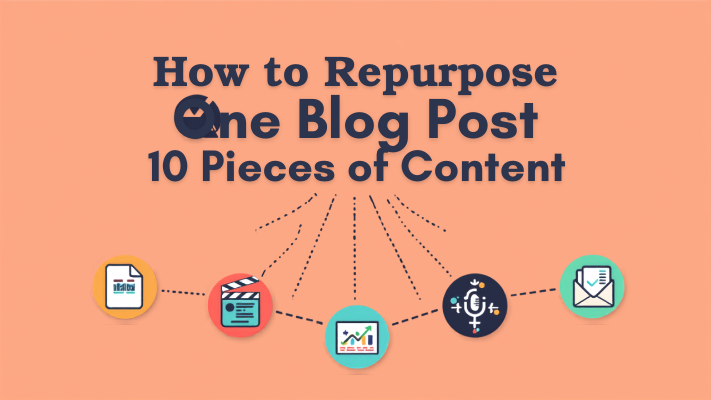
10 Ways to Repurpose One Blog Post
Take one substantial article and work through the following formats.
You don’t necessarily need to create all ten every time. Choose the formats that match where your audience actually spends time.
1. Turn the Core Argument Into a LinkedIn or X Thread
Start with the strongest idea in the article—not the introduction copied word for word.
Turn the central argument into a short sequence:
- Lead with the problem.
- Challenge a common assumption.
- Explain the key insight.
- Give two or three practical takeaways.
- End with a question or a link to the full article.
For example, if your article argues that pageviews are a poor measure of content success, the social version could focus entirely on the difference between traffic and business impact.
The blog provides the depth.
The social post provides the entry point.
2. Turn a Framework Into a Carousel
Carousels work particularly well when your article contains a process, checklist, framework, comparison, or numbered list.
Don’t try to squeeze the entire article onto eight slides.
Instead:
- Slide 1: Make the problem impossible to ignore.
- Slides 2–6: Explain the major points.
- Slide 7: Show the practical takeaway.
- Final slide: Give the reader a next step.
One idea per slide is usually stronger than turning each slide into a miniature paragraph.
A good carousel should make sense even if someone never clicks through to the original article.
3. Turn One Section Into a Short Video
You don’t need to convert the entire blog post into a video.
Choose the section with the strongest combination of problem + insight + payoff.
A simple structure is:
Hook → Problem → Insight → Example → Takeaway
For a 60–90 second video, one strong idea is usually more effective than trying to summarize 1,200 words.
And don’t simply read the blog aloud.
Written content can be dense. Spoken content needs shorter sentences, faster transitions, and language that sounds natural when heard rather than read.
4. Turn the Main Lesson Into an Email
Your newsletter doesn’t need another 1,200-word article.
Pull out the most useful lesson and explain it in three or four concise paragraphs.
A strong email can follow this structure:
Problem → Insight → Example → Link
The email creates curiosity and gives the subscriber enough value to make the click worthwhile.
This also gives older blog content another distribution opportunity without requiring a completely new newsletter topic.
5. Extract a Quote, Statistic, or Contrarian Idea
Every good article should contain at least one sentence worth isolating.
It might be:
- A surprising statistic
- A strong opinion
- A memorable principle
- A concise definition
- A counterintuitive observation
Turn that idea into a simple graphic.
But don’t manufacture a quote just because you need an image. Find something that already carries meaning on its own.
The strongest quote graphics make sense without a long caption explaining what the quote means.
6. Turn Questions Into FAQ Content
Look for questions your article answers explicitly or implicitly.
Then turn those questions into FAQ entries for your website, sales materials, or customer resources.
For example:
Question: How soon should I repurpose a new blog post?
Answer: Start while the research and examples are still fresh, then revisit the article later when you have new data or a different angle.
The important part is to make the FAQ genuinely useful rather than creating thin pages simply to target keywords.
7. Turn the Argument Into a Podcast Segment
A blog post can provide the structure for an entire podcast discussion.
Take the article’s central argument and expand it conversationally.
Instead of reading the article word for word, use it as a discussion outline:
- What problem are people getting wrong?
- Why does the common approach fail?
- What have you seen in practice?
- What should businesses do differently?
- What mistakes should they avoid?
This often produces a more natural discussion than trying to create a podcast topic from scratch.
8. Turn Data or a Key Insight Into a Presentation Slide
A useful statistic, framework, diagram, comparison, or takeaway can become a presentation slide for:
- Webinars
- Sales presentations
- Workshops
- Client meetings
- Conferences
- Internal training
This is particularly valuable because you’re not creating content solely for marketing channels.
A strong article can become part of your company’s sales and educational infrastructure.
9. Turn a Debatable Point Into a Community Discussion
Some ideas are better suited to conversation than broadcasting.
Find the part of your article that people could reasonably disagree with.
Then turn it into a question.
Instead of posting:
“Here are five reasons content repurposing works.”
Try:
“What’s the biggest mistake marketers make when repurposing content?”
The first statement distributes information.
The second invites people to contribute their own experience.
Use the format appropriate to the community rather than dropping promotional links into every discussion.
10. Update the Original Instead of Starting From Zero
Repurposing isn’t limited to creating new formats.
Sometimes the smartest move is improving the asset you already have.
Six months later, revisit the article and ask:
- Are the statistics still accurate?
- Have the platforms changed?
- Are the examples still relevant?
- Can a weak section be replaced with a better one?
- Is there new evidence?
- Has your audience started asking a different question?
An updated article can become the source for another round of social posts, emails, videos, and discussions.
The important point is not to update content mechanically for the sake of appearing “fresh.” Update it when you can make it more accurate, useful, comprehensive, or relevant.
How to Repurpose One Blog Post Into 10 Pieces of Content
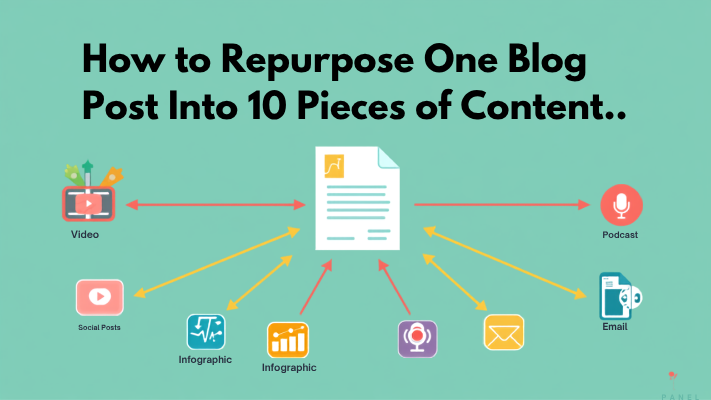
Don’t Repurpose the Article. Repurpose the Ideas.
This is where many content teams get repurposing wrong.
They take the original paragraph and shorten it for LinkedIn.
Then they shorten it again for X.
Then they read the same paragraph into a video.
Then they paste it into an email.
That’s not really repurposing.
It’s duplication.
Instead, separate the idea from the original format.
The same idea might become:
- A detailed explanation in the blog
- A controversial opinion on LinkedIn
- A step-by-step video
- A question in a community
- A statistic in a graphic
- A concise lesson in an email
The underlying knowledge stays the same.
The experience changes.
That is what makes repurposing useful rather than repetitive.
A Simple Content Extraction System
After publishing a blog post, spend 15–30 minutes extracting its raw material.
Step 1: Find the strongest idea
What is the one thing you want the reader to remember?
Turn that into your primary social post or video.
Step 2: Pull out the supporting ideas
Identify three to five points that can stand alone.
These become carousel slides, thread sections, or individual posts.
Step 3: Find the evidence
Look for statistics, examples, research findings, or specific observations.
These can become graphics, presentation slides, or supporting social content.
Step 4: Find the questions
What questions does the article answer?
Those can become FAQs, short videos, community posts, or future articles.
Step 5: Find the strongest language
Look for a memorable sentence, surprising claim, or useful definition.
That becomes a quote post or headline.
Step 6: Match each idea to the right format
Don’t force every idea into every channel.
A detailed process may work as a video.
A strong opinion may work better as a LinkedIn post.
A statistic may be perfect for a graphic.
A complicated explanation may belong in the original article.
Step 7: Schedule instead of dumping
You don’t have to publish everything on the same day.
One article can support content across several days or weeks.
That gives each individual asset room to perform while keeping your publishing pipeline active.
A Practical Repurposing Checklist
After publishing your next article, ask:
- What’s the strongest argument? → LinkedIn/X post
- What are the three biggest takeaways? → Carousel
- What’s the best hook? → Short video
- What’s the most useful lesson? → Newsletter
- Is there a memorable sentence or statistic? → Graphic
- What question does the article answer? → FAQ
- What’s worth discussing? → Podcast topic
- What’s worth presenting visually? → Webinar or presentation slide
- What could people disagree with? → Community discussion
- What will become outdated? → Future update
This turns repurposing from a vague idea into a repeatable workflow.
A Word of Caution: Don’t Manufacture Ten Pieces Just to Hit Ten
The number ten is a useful target, not a requirement.
If only four ideas from an article are genuinely useful outside the original format, create four.
Publishing ten weak pieces is not more efficient than publishing four strong ones.
The purpose of repurposing is to extend the useful life of good ideas, not to fill a content calendar with slightly altered versions of the same paragraph.
Quality still matters.
Relevance still matters.
Platform fit still matters.
And your audience should never feel like you’re recycling the same post at them every few days.
Real-World Example
Imagine a solo marketing consultant publishes a detailed article about pricing strategy for freelancers.
The article contains a pricing framework, three common mistakes, an example calculation, and several practical recommendations.
Instead of immediately starting the next article, the consultant extracts those ideas.
The framework becomes a five-slide carousel.
The three mistakes become a LinkedIn post.
The example calculation becomes a short video.
The strongest observation becomes a quote graphic.
The practical recommendations become a newsletter section.
The most controversial pricing opinion becomes a discussion prompt.
The original article remains the comprehensive resource that connects everything together.
One afternoon of repurposing has now created content for nearly two weeks across several channels—without requiring six completely new ideas.
That’s the real efficiency gain.
How to Repurpose One Blog Post Into 10 Pieces of Content
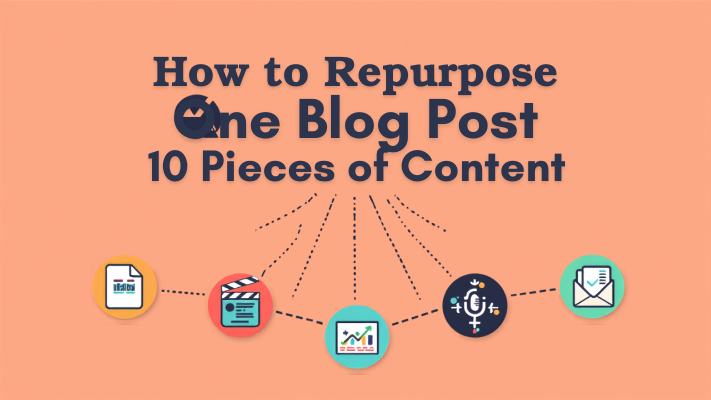
User Experience: Meet People Where They Already Are
Your audience doesn’t owe you a preference for long-form articles.
Some people want detailed explanations.
Some want quick answers.
Some prefer watching.
Some prefer listening.
Some discover ideas through social media and only visit your website when they’re ready to learn more.
Repurposing lets you respect those differences without forcing your team to reinvent the research every time.
But the content should still feel native to the channel.
A LinkedIn post should sound like a LinkedIn post.
A video should sound like a person speaking.
An email should feel like an email.
A carousel should communicate visually.
The idea can remain consistent while the delivery changes.
That’s how you reach more people without making your audience feel like they’re seeing the same piece of content everywhere.
Frequently Asked Questions
Does repurposing hurt SEO if content is duplicated across platforms?
Repurposing itself isn’t inherently an SEO problem. The key is to adapt the content rather than blindly publish identical versions across your own web properties. Social posts, videos, emails, and website content can each serve different purposes and audiences.
How soon after publishing should I start repurposing?
Start soon after publication while the research, examples, and key arguments are still fresh. You can also return to older posts later when you have new information, stronger examples, or a different angle worth exploring.
Do I need design skills to create carousels or graphics?
No. Template-based design tools can handle much of the visual work. More importantly, focus first on the quality of the idea and the clarity of the message. A simple graphic with a strong insight can outperform an elaborate design with nothing useful to say.
What if the original blog post underperformed? Is it still worth repurposing?
Often, yes—but first determine why it underperformed. The topic may have been useful but poorly packaged, difficult to discover, or badly matched to the format. A strong idea can perform very differently as a video, discussion, email, or social post.
Should every blog post become ten pieces of content?
No. Ten is a framework for finding possibilities, not a publishing quota. Some articles may produce three excellent derivatives. Others may contain enough useful material for twenty. Create what genuinely adds value.
Repurposing Formats Compared
| Format | Effort Level | Best Platform | Ideal Source Material |
|---|---|---|---|
| Social thread | Low | X, LinkedIn | Articles with 3–5 clear takeaways |
| Carousel | Medium | Instagram, LinkedIn | Frameworks, checklists, how-to content |
| Short video script | Medium | TikTok, Reels, YouTube Shorts | Strong hooks, opinions, stories |
| Newsletter snippet | Low | Articles with one clear practical lesson | |
| Quote graphic | Low | Instagram, Pinterest | Strong statements, statistics, definitions |
| FAQ entry | Low | Website | Articles answering specific questions |
| Podcast segment | Medium | Podcasts | Strong arguments, stories, or debates |
| Presentation slide | Medium | Webinars, sales, presentations | Statistics, frameworks, comparisons |
| Community discussion | Low | Communities, forums | Debatable opinions and questions |
| Updated article | Medium | Website/Search | Posts with outdated data or examples |
The Real Value of Repurposing
Repurposing isn’t a shortcut for marketers who don’t want to create.
It’s a way to extract more value from work you’ve already done.
Research takes time.
Interviews take time.
Writing takes time.
Editing takes time.
Publishing takes time.
Once you’ve done that work, there is little reason to let the idea live for one week on your blog and then disappear.
A strong article can become a conversation, a video, an email, a presentation, a social post, a customer resource, and eventually an updated article with new insights.
The real bottleneck isn’t always a lack of ideas.
Often, it’s failing to recognize how many useful ideas are already sitting inside the content you’ve created.
Treat each substantial blog post as a content source, not a single finished asset.
Extract the ideas.
Match them to the right formats.
Adapt them for each platform.
Distribute them over time.
Then measure which versions actually earn attention and action.
That’s how one good piece of content can keep working long after the original publish date—and how a small marketing team can build a larger content presence without constantly starting from zero.
Your audience doesn’t need you to create something completely new every day.
They need you to consistently give them something useful in the format they are most likely to consume.